
Stepping out of a warm shower into the Melbourne chill only to reach for a cold, damp towel is a familiar discomfort. Many homeowners consider a heated towel rail as a solution but hesitate, wondering if it’s a true functional upgrade or just an expensive gimmick that will drive up energy bills. Is it a practical investment or an unnecessary luxury?
The truth is, a modern heated towel rail offers far more than simple comfort. It’s a practical addition that improves bathroom hygiene by preventing mildew, gently warms the space, and adds tangible value to your property. But the questions remain: How much do they really cost to run? What is the difference between an electric and a hydronic system? And can one be installed in an existing bathroom without a major renovation?
This guide provides the expert answers you need. We break down the real-world benefits, clarify the running costs in Australian dollars (A$), and compare the different models available. By the end, you will have the clear, reliable information needed to decide if a heated towel rail is a smart, worthwhile investment for your home.
More Than Warm Towels: The Practical Benefits of a Heated Rail
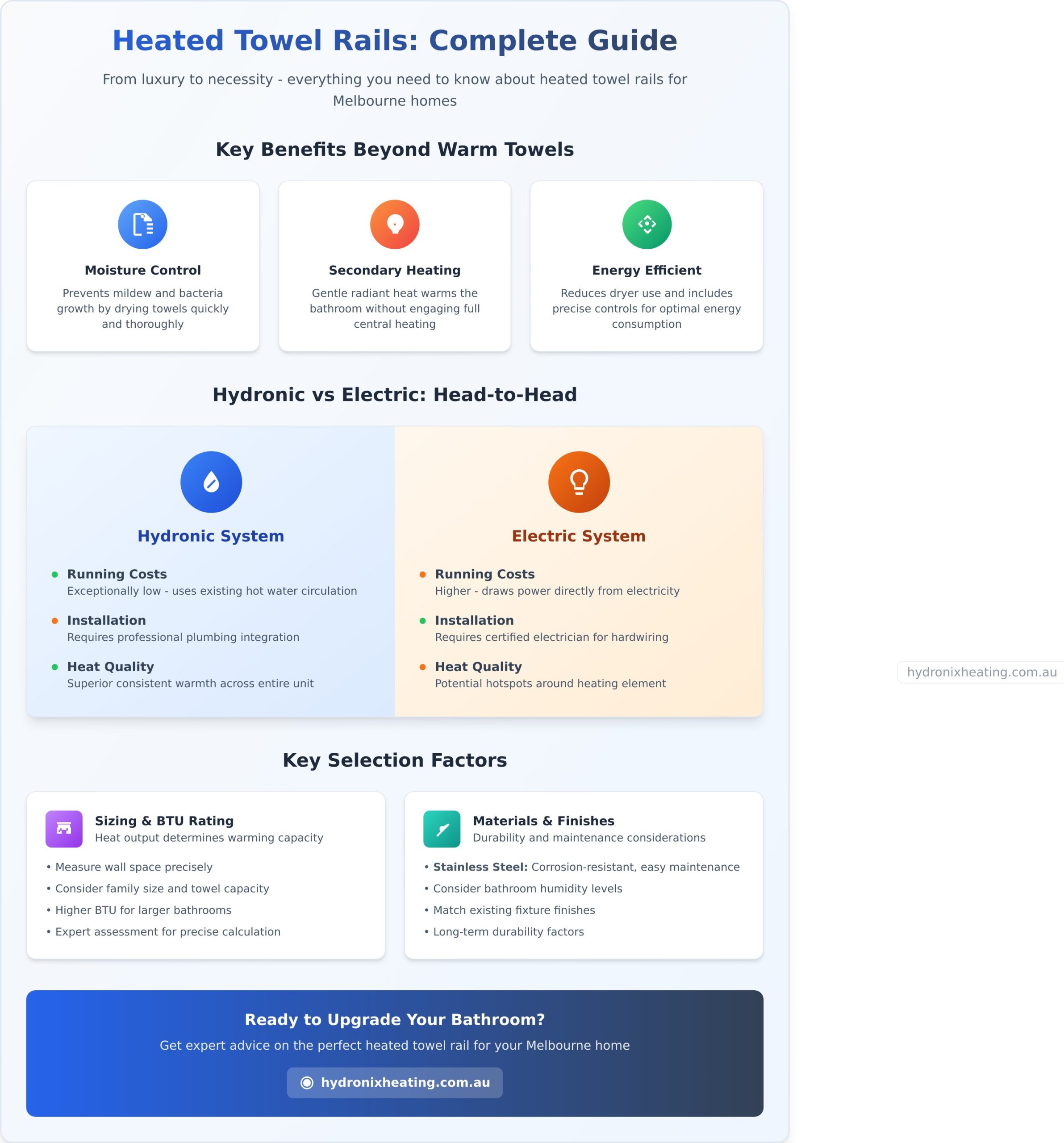
While the immediate appeal of a heated towel rail is the simple luxury of a warm towel, its true value lies in its practical, everyday function. Far from being just an accessory, a modern towel warmer is a hardworking bathroom fixture designed to improve your home’s health and comfort. It serves a crucial dual purpose: efficiently drying towels and providing a gentle source of ambient heat.
Moisture and Mildew Control
Damp towels are a breeding ground for bacteria, leading to musty odours and an unhygienic environment. A heated towel rail tackles this problem at the source by drying towels quickly and thoroughly between uses. This not only keeps them fresh but also helps reduce the overall humidity in your bathroom, a common issue in poorly ventilated spaces. By actively managing moisture, it plays a key role in preventing the growth of mould and mildew, contributing to healthier indoor air quality.
Efficient Secondary Heat Source
Beyond drying towels, these rails provide gentle, radiant heat that takes the chill out of the air. This makes them an excellent secondary heat source, perfect for warming up the bathroom on a cool Melbourne morning without having to engage your entire central heating system. This targeted warmth creates a more comfortable space exactly when you need it, adding a layer of practical comfort to your daily routine.
Energy-Efficient Operation
Modern heating solutions are designed for efficiency, and heated rails are no exception. The benefits are clear:
-
Hydronic Models: When integrated into a hydronic heating system, they are incredibly energy-efficient, using hot water from your boiler to provide consistent warmth.
-
Reduced Dryer Use: By eliminating the need to put damp towels in the tumble dryer, you significantly reduce your electricity consumption.
-
Precise Control: Many models come with thermostats and timers, allowing you to schedule operation and control temperature precisely, ensuring you only use energy when necessary.
Hydronic vs. Electric Heated Towel Rails: A Head-to-Head Comparison
Choosing between a hydronic and an electric model is the most critical decision you’ll make when investing in a heated towel rail. The two types operate on fundamentally different principles. Hydronic rails integrate seamlessly with your home’s central hydronic heating system, using hot water to generate warmth. Electric models, in contrast, are standalone appliances that plug into your home’s wiring. For Melbourne homeowners, this choice directly impacts long-term running costs, installation requirements, and overall performance.
Here’s a direct comparison of the key factors:
Running Costs and Energy Efficiency
A hydronic towel rail uses hot water already being circulated by your boiler, making its additional running cost exceptionally low. It efficiently repurposes heat that your system is already generating. An electric rail, however, functions like any small appliance, drawing power that adds directly to your electricity bill. Over the long term, the energy savings offered by a hydronic system are significant, making it the most cost-effective solution for homes with existing or planned hydronic heating.
Installation Complexity
Hydronic models require professional plumbing to connect them to your central heating pipework. As hydronic heating specialists, we find this process is most efficient and affordable when done during a new build or major bathroom renovation. Electric rails require a certified electrician for safe hardwiring. While generally less complex than new plumbing, this is not a DIY task and must be completed by a licensed professional to meet Australian standards.
Performance and Heating Quality
Hydronic systems provide a superior quality of heat. The hot water flows through all the bars, delivering consistent, gentle, and widespread radiant warmth across the entire unit. Electric models can sometimes have hotspots concentrated around the internal heating element, resulting in less uniform heating. That said, both types effectively warm and dry towels when sized correctly. This rapid drying is crucial, as it significantly inhibits bacterial growth on household towels, keeping them fresher and more hygienic for your family.
Choosing Your Perfect Heated Towel Rail: A Buyer’s Guide
Selecting the right heated towel rail involves more than just aesthetics; it’s a technical decision that impacts your bathroom’s comfort and functionality. A professional choice balances design with practical considerations like your family’s needs, the size of your space, and the unit’s heating capacity. By focusing on a few key factors, you can ensure your investment delivers warmth, efficiency, and style for years to come.
Sizing and Heat Output (BTU)
Before you start browsing, measure your available wall space precisely. The size of the rail dictates its capacity. A large family will require a unit with enough horizontal rungs to dry multiple towels simultaneously. More importantly, check the British Thermal Unit (BTU) rating. This figure measures the rail’s heat output. A higher BTU is necessary to warm a larger bathroom, while a lower BTU is sufficient for a smaller ensuite. For a precise calculation, an expert can assess your room’s dimensions, window size, and insulation to recommend the perfect output.
Materials and Finishes
The material of your heated towel rail affects both its look and its lifespan. Each option offers distinct advantages in terms of durability and maintenance.
-
Stainless Steel: Highly durable, corrosion-resistant, and simple to clean, making it a reliable, long-term choice.
-
Chrome Finish: A classic and popular option that offers a brilliant, reflective surface to complement most bathroom hardware.
-
Matte Black & Other Colours: These powder-coated finishes provide a modern, architectural look and can serve as a bold design statement in a contemporary bathroom.
Consider how each finish will hold up to the humid bathroom environment and the level of care it requires to maintain its appearance.
Design and Style
Functionality often guides design choice. Ladder rails are the most common style, offering maximum practicality for hanging and drying towels. However, the market now includes a vast array of designer options. While classic ladder designs are a trusted choice, many homeowners are exploring other styles, as seen in expert reviews of Bob Vila’s top tested towel warmers, which range from minimalist single bars to striking sculptural pieces that act as functional art. Finally, don’t forget the details-consider the placement of the radiator valves and whether they will be visible, ensuring the final installation is as clean and seamless as the design itself.
Installation: Integrating a Towel Rail Into Your Hydronic System
While the luxury of a warm towel is appealing, achieving it with a hydronic system requires professional expertise. A hydronic heated towel rail is not a simple appliance; it’s a specialised radiator that must be perfectly integrated into your home’s existing central heating circuit. Proper installation is absolutely critical for safety, efficiency, and long-term performance. This is not a DIY task-it requires a licensed hydronic heating specialist.
The Role of a Hydronic Specialist
Engaging a professional is about more than just connecting pipes. A true hydronic expert ensures every component works in harmony. Their role is to:
-
Ensure Correct Integration: They will correctly and safely plumb the towel rail into your boiler’s pipework, preventing leaks and ensuring optimal water flow.
-
Balance the System: A specialist will balance the entire hydronic system, adjusting flow rates to ensure your new rail heats up effectively without drawing too much heat from other radiators in your home.
-
Install Essential Valves: They will fit the correct isolation and control valves, allowing you to manage the rail’s temperature and isolate it for future maintenance without shutting down your entire heating system.
To guarantee your new heated towel rail performs flawlessly from day one, it’s essential to use a team that knows hydronic heating inside and out. hydronic heating installation in Melbourne
Planning for Installation
The ideal time to install a hydronic towel rail is during a bathroom renovation or a new build when walls and floors are accessible. This makes running the necessary pipework simpler and cleaner. Retrofitting a rail into an existing, finished bathroom is also possible, but it is a more complex job that may involve carefully lifting tiles or floorboards. Always discuss placement with your installer beforehand to find the perfect spot that balances aesthetic appeal with optimal heat distribution and practicality.
Connecting to Your Boiler
When connected, your towel rail effectively becomes another radiator or "zone" in your hydronic heating system. Depending on the setup, it can often be configured to run independently of your other radiators, providing warmth in the bathroom even when the rest of the home’s heating is off. However, it’s crucial that your boiler has the capacity to handle this extra load. A qualified technician will assess your boiler’s output to confirm it can support the new rail without impacting the performance of your existing system.
The Verdict: Is a Heated Towel Rail a Smart Investment?
After weighing the benefits and considerations, the decision to install a heated towel rail comes down to your personal priorities and your home’s existing infrastructure. The ‘worth’ is not a simple calculation of cost versus function; it’s an assessment of the value you place on comfort, hygiene, and efficient design. For many Australian homeowners, the daily luxury of a warm, dry towel combined with a healthier bathroom environment makes it an undeniable asset.
The choice between system types is clear. If your home is equipped with hydronic heating, a hydronic towel rail is a logical and highly efficient extension of that system. It leverages your boiler’s power to provide warmth at a minimal running cost. For homes without hydronic infrastructure, an electric model offers a straightforward, standalone solution.
It’s a Great Investment If…
A heated towel rail is an excellent addition to your home under these circumstances:
-
You have a hydronic heating system. Integrating a hydronic rail is a seamless and energy-efficient way to enhance your bathroom’s comfort and functionality, using the same reliable heat source as the rest of your home.
-
You prioritise hygiene. You want to permanently solve the problem of damp, musty towels and reduce the potential for mould and bacterial growth in your bathroom.
-
You desire gentle, ambient warmth. The rail can act as a secondary radiator, taking the chill out of the air and making your bathroom a more inviting space, especially on cold mornings.
-
You are renovating or building. This is the most cost-effective time to install the necessary plumbing for a hydronic model, ensuring a clean, professional finish.
You Might Reconsider If…
On the other hand, it may not be the right choice for you at this time if:
-
Your renovation budget is strictly limited. With quality units and installation in Australia costing anywhere from A$800 to over A$2,500, it is a significant investment that may not fit a tight budget.
-
You have no plans for a whole-home hydronic system. While an electric model is an option, a hydronic rail is not practical as a standalone installation without a boiler system.
-
Bathroom wall space is at a premium. If your bathroom is compact, dedicating wall space to a rail might compromise storage or movement.
-
You need a primary heat source. A heated towel rail provides supplementary warmth but lacks the output to effectively heat a large or poorly insulated bathroom on its own.
Ultimately, the right decision is based on expert advice and a clear understanding of your needs. If you’re exploring hydronic heating solutions for your home, our specialists can help you determine if a towel rail is the perfect finishing touch for your system. hydronic heating installation in Melbourne
The Verdict: A Smart Investment in Everyday Comfort
Ultimately, a heated towel rail is far more than an indulgence for your Melbourne home. It’s a practical addition that reduces bathroom moisture, keeps towels fresh, and adds a touch of daily luxury. For homeowners with an existing hydronic system, a hydronic model represents a highly efficient and seamless upgrade, transforming your bathroom into a consistently warm and inviting space.
Making the right choice requires expert guidance. As Melbourne’s trusted hydronic heating specialists, Hydronix Heating provides expert installation and flawless system integration. Our work is meticulous, reliable, and backed by a comprehensive six-year workmanship guarantee, giving you complete peace of mind.
Ready to enhance your home’s comfort and value? hydronic heating installation in Melbourne Experience the difference that professional craftsmanship can make in your home today.
Frequently Asked Questions
How much does a heated towel rail cost to run?
Running costs depend on the type. An electric heated towel rail typically uses 100-200 watts, costing just 3-6 cents per hour based on average Australian electricity rates. A hydronic model is even more efficient as it runs as part of your central heating system. The cost is integrated into your boiler’s operation, which provides a highly efficient and cost-effective way to warm your towels and bathroom, making it an economical choice for long-term use.
Can a heated towel rail heat my entire bathroom?
Most standard towel rails are designed to warm and dry towels, not for primary space heating. While they will add some ambient warmth, they typically lack the output to heat an entire bathroom alone. For effective heating, a larger, radiator-style hydronic towel rail is the expert solution. These are correctly sized by specialists to act as the room’s main heat source, providing powerful, radiant warmth for complete comfort. We can advise on the correct model for your space.
Can I leave a heated towel rail on all the time?
Yes, heated towel rails are designed for continuous and safe operation. Electric models are low-wattage appliances, and many can be fitted with timers for automated control and greater efficiency. Hydronic models operate as part of your main heating system, running whenever your heating is active. Leaving them on ensures your towels remain dry, warm, and free from mildew, providing consistent comfort and hygiene in your bathroom. They are built for reliable, constant performance.
How hot do heated towel rails get to the touch?
Heated towel rails are designed to be hot enough to dry towels effectively but safe to the touch for brief contact. Surface temperatures typically range between 45°C and 60°C, depending on the model and system settings. While hot, they are manufactured to Australian safety standards to prevent instant burns. However, as with any heating appliance, we advise caution, particularly in households with young children, to ensure a safe bathroom environment for everyone.
Can you install a heated towel rail in an existing bathroom?
Absolutely. Installing a heated towel rail into an existing bathroom is a common and straightforward project for qualified professionals. An electric model requires a licensed electrician for wiring. A hydronic model requires a specialist hydronic technician to connect it to your existing boiler and pipework. Our expert team can retrofit hydronic rails with minimal disruption, providing a seamless and highly efficient upgrade to your bathroom’s comfort and luxury.
What maintenance does a hydronic heated towel rail require?
A hydronic heated towel rail itself requires very little direct maintenance, as it has no complex internal components. Its upkeep is part of the annual service for your entire hydronic heating system. During a professional service, a technician will check for leaks, ensure proper water pressure, and bleed any trapped air from the rail to guarantee optimal performance. This simple, routine check ensures your system remains reliable and efficient for years to come.