

Watching your gas and electricity bills climb higher every season is a familiar frustration for many Melbourne homeowners. If you’re looking for a genuine, long-term solution to high energy costs and inefficient heating, it’s time to look beyond traditional systems. The answer for reliable, year-round comfort lies in one of the most misunderstood but effective technologies available today: heat pumps. But the name can be misleading. How can a system create heat from cold air, and is it really suitable for the unpredictable Melbourne climate?
A well-maintained heat pump typically has a lifespan of 10 to 15 years. The longevity of the system is directly influenced by the quality of the initial installation and the consistency of professional annual servicing. With proper care and timely repairs from a trusted specialist like Hunter Heating and Cooling, some high-quality units can operate efficiently for even longer, providing reliable year-round comfort for your home.
In this straightforward guide, we cut through the confusion. We’ll explain the simple science behind how heat pump technology works, break down the main types available, and show you why it is the single most energy-efficient way to both heat and cool your home. You will discover how making the switch can significantly lower your running costs and reduce your environmental footprint, giving you complete control over your home’s comfort and your energy spending.
How Does a Heat Pump Actually Work? (The Simple Explanation)
The fundamental principle behind a heat pump is surprisingly simple: it moves existing heat from one place to another, rather than creating heat by burning fuel. The best analogy is a refrigerator working in reverse. Your fridge pulls heat from inside the unit and releases it into your kitchen. A heat pump does the opposite, extracting latent heat from the outside air-even on cold days-and efficiently transferring it inside to warm your home. For a more detailed technical breakdown of how a heat pump works, you can explore comprehensive resources online.
This ingenious process of transferring, rather than generating, heat is the secret to their incredible efficiency. Because the same system can reverse its operation during summer, many heat pumps also act as highly effective air conditioners, moving heat from inside your home to the outside to provide year-round comfort from a single, reliable unit.
The Four Key Components
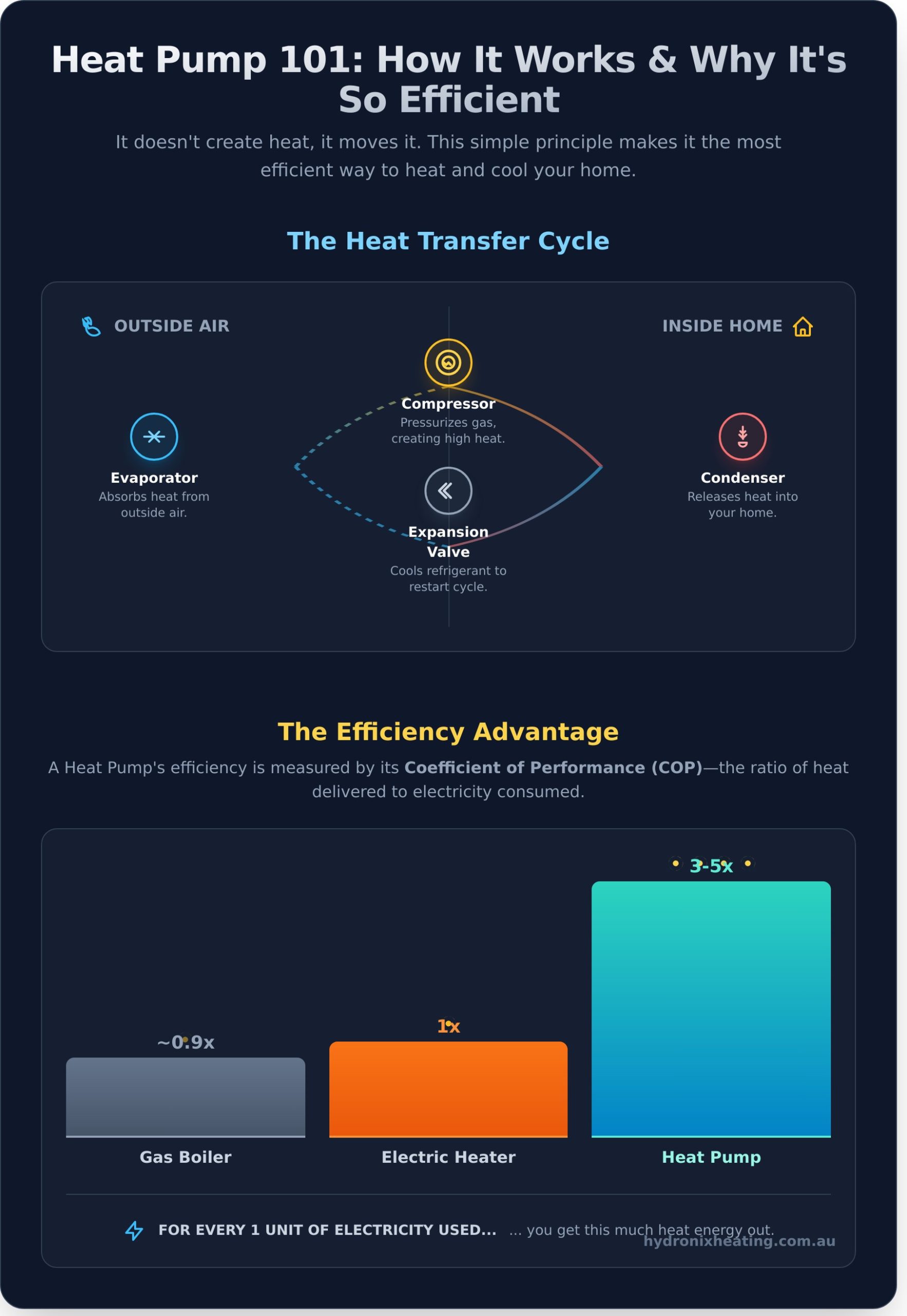
Every heat pump system relies on four main parts working together in a continuous, sealed loop to move heat.
-
Evaporator: This coil absorbs ambient heat from the source (air, ground, or water). This energy causes a special liquid refrigerant inside the coil to boil and turn into a low-temperature gas.
-
Compressor: This is the heart of the system. It takes the low-temperature gas and pressurises it, a process which significantly increases its temperature.
-
Condenser: Located inside your home, this coil allows the hot, high-pressure gas to release its captured heat, warming your space as it condenses back into a liquid.
-
Expansion Valve: The now-liquid refrigerant passes through this valve, which rapidly lowers its pressure and temperature, preparing it to absorb heat at the evaporator and start the cycle all over again.
Understanding the Coefficient of Performance (COP)
A heat pump’s efficiency is measured by its Coefficient of Performance (COP). This is a straightforward ratio of the heat energy it outputs versus the electrical energy it consumes. Most modern heat pumps have a COP between 3 and 5.
In practical terms, this means for every 1 kilowatt (kW) of electricity the system uses, it delivers an impressive 3 to 5 kW of heating energy into your home. This level of efficiency far surpasses traditional heating methods. For comparison, a high-efficiency gas boiler has a "COP" of around 0.9 (meaning some energy is always lost), while a standard electric heater has a COP of 1-it can only ever produce 1 kW of heat for every 1 kW of electricity it consumes.
The Main Types of Heat Pumps for Your Home
Heat pumps are primarily categorised by where they draw their thermal energy from: the air, the ground, or a water source. Understanding these differences is key to selecting the most reliable and energy-efficient alternative for your specific property. The right choice depends on a careful assessment of your home’s location, your local climate, and your budget. Each type offers distinct advantages, making one a better fit than another depending on your circumstances.
Let’s break down the three main types of heat pumps available for residential use in Australia.
Air Source Heat Pumps
This is the most popular and affordable type of heat pump system in Australia. Air source models work by extracting latent heat from the ambient air outside-a process that remains effective even on cold winter days. They are versatile and can be configured in two primary ways:
-
Air-to-Air: These systems distribute warm or cool air throughout your home via a ducted or split-system network, similar to a standard reverse-cycle air conditioner.
-
Air-to-Water: An expert choice for whole-home comfort, these models transfer the captured heat to water. This hot water is then used to power a hydronic heating system, such as in-slab heating or wall-mounted panel radiators.
Ground Source (Geothermal) Heat Pumps
Ground source, or geothermal, heat pumps leverage the stable temperatures found deep in the earth. A network of pipes is buried underground, and a fluid circulates through them to absorb the earth’s constant heat. Because the ground temperature remains consistent year-round, these systems are exceptionally efficient and are not affected by outdoor air temperature fluctuations. While the groundwork and excavation result in a higher upfront cost (A$), their outstanding performance makes them a superb long-term investment, particularly for new builds or properties with significant land.
Water Source Heat Pumps
A more specialised option, water source heat pumps operate by drawing heat from a nearby body of water, such as a pond, lake, or river. This method is highly efficient because water can store a large amount of thermal energy. However, its application is limited to properties with direct and suitable access to a water source, making it an uncommon choice for typical suburban homes. For the right property, it offers reliable and very low-cost heating and cooling.
Why Choose a Heat Pump? The Top 4 Benefits
Modern heat pumps offer a significant upgrade over traditional heating and cooling systems. For homeowners looking to improve comfort, reduce running costs, and lower their environmental impact, switching to a heat pump is one of the most effective investments you can make. It’s a reliable, forward-thinking solution that prepares your home for the future of energy in Australia.
1. Unmatched Energy Efficiency & Lower Bills
The primary advantage of a heat pump is its exceptional energy efficiency. Unlike gas boilers or electric radiators that create heat by burning fuel or resisting electricity, a heat pump works by moving existing heat from one place to another. This process, which you can learn more about in resources explaining how heat pumps work, allows them to achieve a Coefficient of Performance (COP) of 3 to 5. In simple terms, for every 1kW of electricity consumed, the system delivers 3 to 5kW of heating energy. This translates directly to a drastic reduction in your energy bills and insulates your household from volatile gas prices.
2. All-in-One Heating and Cooling
Many modern air source heat pumps are reverse-cycle systems, providing a complete, year-round climate control solution in a single unit. During winter, they efficiently extract heat from the outside air to warm your home. In summer, the process is simply reversed to extract heat from inside and move it outdoors, delivering powerful and efficient cooling. This dual functionality eliminates the need for separate heating and air conditioning systems, saving space and simplifying maintenance.
3. A Greener Choice for the Environment
By choosing a heat pump, you are actively reducing your household’s carbon footprint. Because they run on electricity, they don’t burn fossil fuels like natural gas directly in your home, eliminating local emissions. The environmental benefits are even greater when you pair your system with a rooftop solar panel installation-a popular choice for many Australian homes. This combination allows you to power your heating and cooling with clean, renewable energy, creating a near-zero emissions solution for home comfort.
4. Government Incentives & Future-Proofing
To encourage the transition to cleaner energy, Australian federal and state governments often provide rebates and incentives for installing high-efficiency heat pumps. These programs can significantly reduce the upfront installation cost, making the switch more accessible. By investing in this technology, you not only benefit from immediate savings but also future-proof your home against rising energy costs and add tangible value to your property. It’s a smart, strategic upgrade for any modern home.
Common Applications: How Heat Pumps Are Used in Homes
The versatility of heat pump technology is one of its greatest strengths, extending far beyond simple air conditioning. These systems can be integrated in several ways to provide complete, energy-efficient home comfort. While effective on their own, the true power of heat pumps is unlocked when they are paired with a highly efficient distribution method. It is in these applications that the technology truly shines for Melbourne homes, delivering unparalleled performance and significant long-term energy savings.
Standard Space Heating (Split Systems)
For many Australians, the most familiar application is the reverse-cycle split system. This setup connects an outdoor compressor unit to one or more indoor, wall-mounted units. It’s a reliable and effective solution for heating or cooling individual rooms and open-plan living areas, offering targeted climate control exactly where you need it most. While practical, it is just the starting point for this technology’s capabilities.
Efficient Hot Water Systems
Applying the same core principle, a heat pump hot water system extracts warmth from the ambient air to heat your home’s water supply. These systems are a game-changer for household energy bills, operating up to four times more efficiently than older, conventional electric storage tanks. This makes upgrading to a heat pump water heater a smart, straightforward way to significantly reduce your home’s overall energy consumption.
The Ultimate Solution: Powering Hydronic Heating
This is where modern heat pump technology provides the most value and comfort. An advanced air-to-water heat pump can directly replace a traditional gas boiler, becoming the new, highly efficient heart of a hydronic heating system. Instead of blowing hot air, it heats water that circulates silently through a network of underfloor piping or sleek panel radiators.
The result is a superior form of comfort: gentle, consistent, and radiant warmth that heats objects and people directly. This eliminates the drafts, noise, and dry air associated with forced-air systems. It is the most energy-efficient and sophisticated way to experience luxurious hydronic heating. By combining these two leading technologies, you create a system that is not only cost-effective to run but also future-proofed for an all-electric home. To learn more about upgrading your system, it is essential to consult with a trusted hydronic heating specialist.
Key Considerations for Installing a Heat Pump in Melbourne
While highly effective, transitioning to a heat pump system in Melbourne requires careful planning for a successful outcome. Success depends on choosing the right system for our variable climate, ensuring it’s designed and installed by a professional, and understanding the balance between the upfront investment and significant long-term savings on your energy bills.
Will It Work Effectively in Melbourne Winters?
A common question we hear is whether heat pumps can handle a Melbourne winter. The answer is a definitive yes. Modern systems are engineered to operate with remarkable efficiency even in temperatures that dip below freezing. Thanks to significant technological advancements, they are a reliable and powerful heating source that will keep your home comfortable all winter long, provided the unit is correctly specified for your home’s unique needs.
The Importance of Correct Sizing and Installation
Correct sizing and installation are non-negotiable for performance and efficiency. An undersized unit will constantly struggle to reach your desired temperature on the coldest days. Conversely, an oversized unit will cycle on and off too frequently-a process known as short-cycling-which wastes energy and causes unnecessary wear on components. This is why professional system design is critical to protect your investment. To ensure optimal efficiency and comfort, trust Melbourne’s hydronic heating specialists for expert advice.
Upgrading Your Existing System
For homes with an existing hydronic system, the transition is often seamless. A high-efficiency heat pump can be expertly retrofitted to replace an outdated or inefficient gas boiler, allowing you to continue using your current panel radiators or underfloor heating coils. This is a powerful upgrade that not only boosts your home’s energy efficiency and reduces its carbon footprint but also delivers substantial, lasting reductions in your heating bills. Ask us about upgrading your boiler to a high-efficiency heat pump.
Your Next Step Towards Year-Round Comfort
As we’ve explored, modern climate systems offer a revolutionary approach to home comfort. They are a smart, all-in-one solution, providing highly efficient warmth in winter and refreshing cooling in summer from a single unit. This incredible efficiency translates directly into significant savings on your energy bills and a more sustainable way to keep your Melbourne home perfectly comfortable through every season.
For homeowners looking to maximise these benefits, combining heat pumps with a hydronic heating system creates an unbeatable standard of reliable, radiant warmth. As Melbourne’s trusted hydronic heating specialists, the team at Hydronix Heating offers expert system design and professional installation tailored to your property. We stand behind our work with a comprehensive six-year workmanship guarantee, giving you complete peace of mind in your investment.
Ready to experience a new level of efficiency and comfort? Discover the future of comfort with Heat Pump Hydronic Heating.
Frequently Asked Questions About Heat Pumps
Are heat pumps noisy to operate?
Modern heat pumps are surprisingly quiet. Advances in technology mean the outdoor unit typically operates at around 40-60 decibels-comparable to a quiet conversation or a modern refrigerator. Indoor units are even quieter, often whispering at a level similar to a computer fan. This ensures your home comfort isn’t disrupted by loud operational noise, a significant improvement over older air conditioning systems.
How much maintenance does a heat pump require?
To ensure optimal performance and efficiency, a heat pump requires an annual professional service. This check-up by a qualified technician involves inspecting coils, checking refrigerant levels, and ensuring all components are functioning correctly. Homeowners can help by regularly cleaning or replacing the indoor unit’s air filters every few months, which maintains airflow and system efficiency. Proper maintenance is key to a long and reliable service life.
What is the average lifespan of a heat pump?
A well-maintained heat pump typically has a lifespan of 10 to 15 years. The longevity of the system is directly influenced by the quality of the initial installation and the consistency of professional annual servicing. With proper care and timely repairs from a trusted specialist, some high-quality units can operate efficiently for even longer, providing reliable year-round comfort for your home.
Can a heat pump completely replace my old gas heating system?
Yes, in almost all situations, a correctly sized heat pump can completely replace a traditional gas heating system. It provides both highly efficient heating in winter and cooling in summer, making it a true all-in-one climate solution. For homes with hydronic systems, a specialised air-to-water heat pump can directly replace a gas boiler, offering a seamless transition to a more energy-efficient setup.
Are there any government rebates for installing a heat pump in Victoria?
Yes, Victorian households can access significant government rebates for installing energy-efficient heat pumps. The Victorian Energy Upgrades (VEU) program offers substantial incentives that can reduce the upfront installation cost by thousands of dollars. These rebates are designed to encourage the switch from older, less efficient systems like gas heating. An accredited provider can confirm your eligibility and manage the rebate application for you.
How does a heat pump for hydronic heating differ from one for a split system?
The key difference lies in what they heat. A standard split system heat pump is an "air-to-air" unit; it transfers heat to or from the air and distributes it via an indoor fan coil. A heat pump for hydronic heating is an "air-to-water" system. It extracts heat from the air and uses it to heat water, which is then circulated through radiators or in-floor pipes to warm the home.