

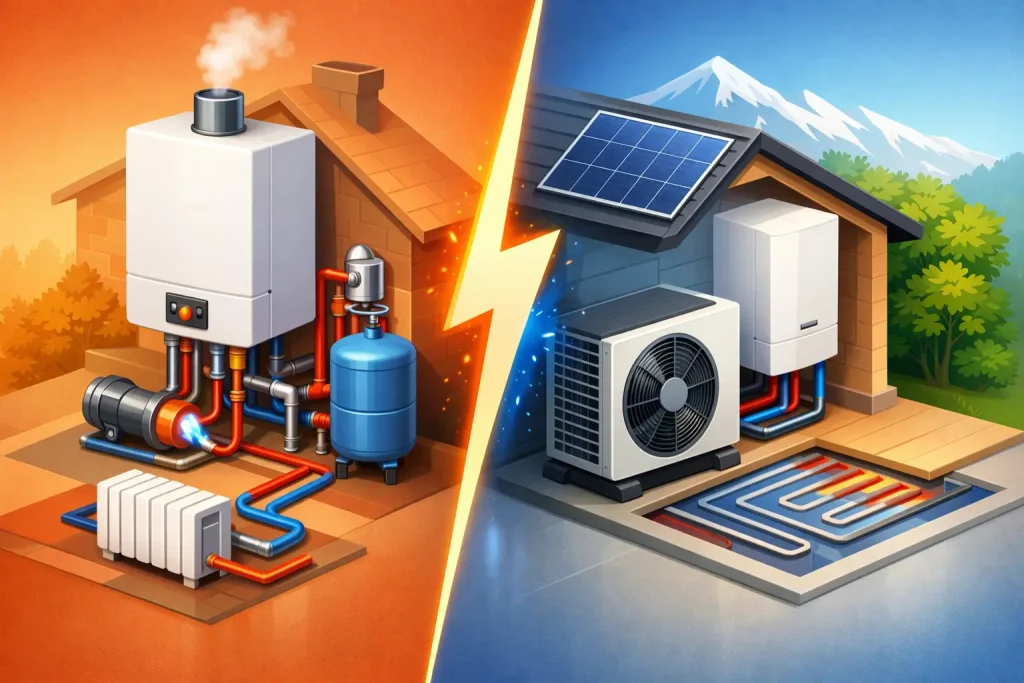
If your current heating is ageing, underperforming or costing more to run each winter, the petrol boiler vs heat pump hydronic question stops being theoretical very quickly. For Melbourne homeowners, the right answer usually comes down to how your existing system is built, how warm you want the home to feel on cold mornings, and whether you are upgrading for efficiency, reliability or both.
Hydronic heating is not one product. It is a system. The heat source might be a petrol boiler or a heat pump, but the performance you actually live with depends on the emitters, pipework, controls, insulation levels and how well the whole system has been designed. That is why blanket advice often leads to expensive mistakes.
Petrol boiler vs heat pump hydronic: the real difference
A petrol boiler heats water quickly and can deliver high water temperatures with ease. That makes it naturally suited to radiator systems and older homes where the heat demand is higher, especially during Melbourne winter cold snaps. If you already have a hydronic setup built around a boiler, replacing an older unit with a modern condensing model is often the most direct route to better efficiency and reliable heat.
A heat pump works differently. It moves heat rather than creating it through combustion, which can make it far more efficient under the right conditions. The catch is that hydronic heat pumps generally perform best at lower water temperatures. That suits underfloor heating very well and can also suit oversized radiators or fan coil systems, but not every existing radiator layout will deliver the same comfort at those lower temperatures.
That is the first point many homeowners miss. A heat pump is not automatically a straight swap for a petrol boiler, even if both can technically heat water for a hydronic system.
When a petrol boiler still makes sense
There is a strong case for petrol in many established homes, particularly where the hydronic system is already designed around medium to high temperature water. If your radiators were sized for a traditional boiler, a new condensing petrol boiler can often slot into the system with fewer changes, less disruption and a more predictable result.
It also matters how you use the home. If you want fast heat recovery, keep large areas consistently warm, or have a draughtier property with high ceilings and older construction, a boiler can still be the better fit. Petrol boilers respond quickly and cope well with demanding winter loads.
From a service point of view, boilers also remain a practical option because faults can often be diagnosed and repaired without rebuilding the whole system. In many cases, homeowners are told to replace when the issue is actually a failed pump, valve, sensor, heat exchanger problem or control fault. A specialist will separate repairable problems from genuine end-of-life issues before recommending a full upgrade.
That matters because replacement is not always the smartest spend. We fix systems others replace is not a slogan for effect – it reflects the reality that many hydronic systems still have years of life left with the right repair and servicing plan.
When a heat pump hydronic system is the better choice
Heat pump hydronic can be an excellent option, but it is strongest when the house and system are suited to it from the outset. New builds, major renovations and homes with well-insulated envelopes are usually the easiest fit. Underfloor hydronic heating is particularly well matched because it runs efficiently at lower temperatures while still delivering even, comfortable warmth.
There is also a long-term energy argument. If you are trying to reduce reliance on petrol, planning for electrification, or pairing heating with rooftop solar, a heat pump starts to look more attractive. The operating cost can be favourable, especially when the system is designed properly and not forced to do a job it was never set up to handle.
The key phrase there is designed properly. If a heat pump is connected to undersized radiators in a home with high heat loss, the result may be long run times, disappointing comfort and a system that looks good on paper but struggles in practice. The equipment is not necessarily the problem. The design assumptions are.
Running costs are only one part of the equation
Homeowners often start with the question, which is cheaper to run? That is fair, but it should never be the only question.
A heat pump can be more efficient than a petrol boiler in terms of energy conversion. However, your real-world running cost depends on electricity tariffs, petrol prices, insulation quality, zoning, control strategy and required water temperature. In some homes, the savings are meaningful. In others, the gap narrows once you account for retrofit costs and performance compromises.
A modern condensing boiler can also be significantly cheaper to run than an older non-condensing unit, particularly if the existing system is cleaned, balanced and controlled correctly. That is why honest advice starts with the house and the system, not a headline claim about one technology being universally cheaper.
Retrofit complexity: where decisions get expensive
The biggest hidden cost in the petrol boiler vs heat pump hydronic decision is usually not the appliance. It is what has to change around it.
If your current pipework, radiators and controls are all suitable for a condensing boiler upgrade, the project can be relatively straightforward. You improve efficiency, restore reliability and keep the system architecture that already works for the home.
A heat pump retrofit can involve more moving parts. You may need larger radiators, buffer tanks, control changes, electrical upgrades or a rethink of zoning. None of that makes heat pumps a poor option. It simply means the proposal needs to be grounded in proper heat loss calculations and practical site knowledge.
This is where specialist hydronic advice matters. A general plumbing quote may price the box on the wall. A hydronic specialist looks at emitter output, flow temperatures, hydraulic separation, cycling risk and whether the comfort level you expect is actually achievable.
Comfort is where homeowners notice the difference
Most people do not care about heating technology for its own sake. They care that the house feels warm, steady and predictable.
Petrol boilers tend to suit homeowners who want strong output and quick response, particularly in radiator-based systems. Heat pumps tend to excel where steady-state operation and lower water temperatures align with the way the home loses and holds heat.
Neither is automatically better for comfort. A well-designed system is better for comfort. Poorly matched equipment, on the other hand, creates the same complaints every winter: cold rooms, tepid radiators, noisy operation, high bills and constant thermostat adjustments.
That is why the right question is not just petrol or heat pump. It is what heat source suits this property, this hydronic layout and this household.
What Melbourne homeowners should weigh up
Melbourne homes vary widely. A newer build in the inner suburbs with excellent insulation is a very different heating challenge from a larger period home in the east with original features and higher heat loss. The answer that works in one property can be the wrong one a few streets away.
If you already have a functioning hydronic radiator system and the boiler is the weak point, a condensing boiler upgrade often offers the clearest path to dependable winter performance. If you are building, extending or reworking the emitters anyway, heat pump hydronic deserves serious consideration.
There is also a timing issue. If your current system has failed in the middle of winter, the fastest route back to heat may not be a full redesign. In those situations, good advice protects you from panic spending. Diagnose first, repair where sensible, and only replace when the numbers and the outcome support it.
How to choose without guessing
Start with a proper assessment of the existing system. That means checking the condition of the boiler or heat source, the suitability of the radiators or underfloor circuits, the controls, the pipework and the heat demand of the home. Without that, every recommendation is half-informed.
Then weigh up three things together: upfront cost, likely running cost and the quality of heat you expect day to day. The cheapest install can become the most frustrating system to live with. Equally, the most expensive upgrade is not automatically the wisest if your current setup can be repaired and improved.
For many homeowners, the best outcome is not choosing the newest technology. It is choosing the system that will heat the house properly, service well over time and not force unnecessary changes onto an otherwise sound hydronic layout.
That is the value of specialist advice. You want a heating contractor who understands both repair and replacement, because they have no reason to push a full changeover when a better-targeted fix or upgrade will do the job.
If you are weighing up your next move, do not start with the brochure claim. Start with what your home actually needs to stay reliably warm through a Melbourne winter, and let the system choice follow from that.