
If your boiler is ageing, noisy, or pushing your energy bills up every winter, the choice often comes down to one question: condensing vs standard boiler. For most homeowners, this is not really about boiler jargon. It is about whether your home heats properly, whether your running costs stay under control, and whether you are being told to replace a boiler that may still be repairable.
Hydronic systems are all we do, so we see this decision in real homes – not in brochures. Some boilers still have good years left in them with the right repair. Others are costing more to run than they should, and an upgrade makes financial sense. The right answer depends on the boiler itself, the age of the system around it, and how the home is used.
Condensing vs standard boiler: what is the difference?
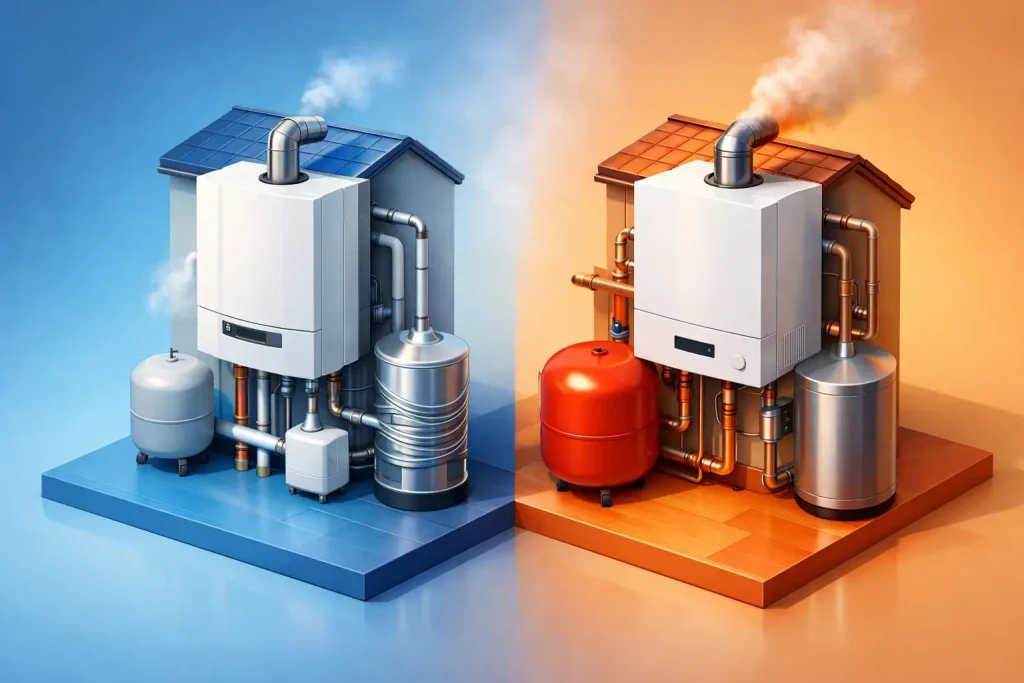
A standard boiler, sometimes called a non-condensing boiler, heats water and sends combustion gases out through the flue. A lot of heat goes with those gases. That was normal for older boiler design, but it means more wasted energy.
A condensing boiler is built to recover more of that heat before it leaves the system. It does this by extracting heat from the flue gases and using it to preheat the returning water. That extra heat recovery is what lifts efficiency and reduces petrol consumption.
In practical terms, the main difference is not just the unit on the wall. It is how much useful heat you get from the fuel you pay for. A standard boiler throws more of that heat away. A condensing boiler is designed to keep more of it in the system.
Why condensing boilers usually cost less to run
For most households, the strongest case for a condensing boiler is lower running cost. Hydronic heating is prized for comfort, but if the boiler is inefficient, that comfort becomes expensive.
A condensing boiler can be far more efficient than an older standard unit, especially when the system is set up correctly and return water temperatures are low enough for condensing mode to work as intended. That matters in hydronic heating because radiators, panel systems and in-slab circuits can all benefit from steady, controlled heat rather than hard on-off firing.
That said, the headline efficiency figures you see advertised do not appear by magic. The boiler has to be matched to the home, commissioned properly and integrated with the existing system. Poor pipework design, dirty water, failed controls or oversized equipment can undermine performance. This is why specialist diagnosis matters more than brochure claims.
Standard boilers still have a place in some homes
It is easy to talk as though standard boilers are obsolete in every case. The reality is more measured than that.
If you have a well-built older boiler that is operating reliably, and the fault is minor, repair can be the smarter option. Many established homes in Melbourne still run older hydronic systems that respond well to targeted repairs, component replacement and proper servicing. Throwing out a boiler just because it is not condensing is not always good advice.
There are also situations where a full upgrade involves more than changing the boiler. Flueing, condensate drainage, controls, petrol line sizing and system balancing may all need attention. If the wider system has issues, the installation needs to be planned properly rather than rushed through as a simple swap.
This is where homeowners get caught. A generalist may push replacement because it is easier than diagnosing the actual cause of poor performance. A specialist will first work out whether the boiler is the problem, or whether the problem sits elsewhere in the system.
Condensing vs standard boiler for older hydronic systems
Older homes with hydronic heating often have excellent heat distribution but mixed equipment history. You may have original radiators, later pipe alterations, ageing valves and a boiler that has had multiple repairs over time. In these cases, condensing vs standard boiler is rarely a standalone decision.
A condensing boiler can work very well with older radiators, but only if the system water quality is right and the controls are configured properly. Sludge, magnetite and poor circulation can shorten boiler life and reduce efficiency. Before any upgrade, the system needs to be assessed as a whole.
Equally, an existing standard boiler in an older home may still be worth repairing if the heat exchanger is sound, spare parts are available and the repair cost is proportionate. Repair-first thinking protects homeowners from unnecessary expense. It also avoids replacing equipment when the true fault may be a pump, pressure issue, valve failure or control fault.
Installation cost versus long-term value
The main argument against condensing boilers is upfront cost. A quality upgrade will usually cost more than a repair to a working standard boiler, and more than a like-for-like basic replacement.
But upfront cost on its own is not the right measure. You also need to look at fuel savings, reliability, serviceability and expected remaining life of the current boiler. If a standard boiler is requiring repeated repairs, struggling to maintain temperature, or driving high petrol bills, it may be more expensive to keep than to replace.
For busy households, there is another factor: downtime. A failing older boiler often does not choose a convenient week to stop. It fails in winter, when parts can be harder to source quickly and the home becomes uncomfortable fast. Planned upgrades are usually cleaner, calmer and better value than emergency replacements done under pressure.
Which boiler is more reliable?
Reliability is not just about whether a condensing or standard boiler has more components. It is about the condition of the system, the quality of the installation and whether the appliance is serviced properly.
Older standard boilers are sometimes described as simpler and therefore more dependable. There is some truth in that, particularly where units have fewer electronic controls. But age brings its own reliability problems. Heat exchangers corrode, seals fail, ignition parts wear out and spare parts become harder to source.
Condensing boilers are more advanced, and they need correct setup and annual servicing. When installed well, they are highly reliable. When installed poorly, they can become frustrating very quickly. This is why workmanship matters. The right boiler fitted badly will still underperform.
When repair makes more sense than upgrade
A good contractor should be able to tell you plainly when to repair and when to replace. If the boiler has a specific component failure, the rest of the unit is in sound condition, and parts are available, repair is often the sensible choice.
This is especially true where the existing standard boiler is heating the home evenly, maintaining pressure and not showing signs of major internal deterioration. In that case, a measured repair can buy valuable time and let you plan an upgrade on your terms rather than in an emergency.
We fix systems others replace, and that approach protects homeowners from paying for work they do not yet need. A repair-first decision is not about avoiding upgrades forever. It is about making the upgrade at the right time, for the right reasons.
When a condensing boiler upgrade is the better move
A condensing boiler becomes the stronger option when the old unit is inefficient, unreliable, unsupported for parts or oversized for the property. It is also a good fit where homeowners want lower running costs and better control over room temperatures.
If you are already spending money on repeated call-outs, noticing uneven performance, or planning other heating improvements, an upgrade can make the whole system work better. Modern condensing boilers pair well with updated controls and can deliver more stable, economical heating across the home.
The key is proper specification. The boiler should suit the heat load of the property, not simply mirror the size of the old unit. Oversizing was common in the past and often leaves homeowners paying for output they never needed.
What homeowners should ask before deciding
Before choosing between condensing vs standard boiler, ask for a diagnosis rather than a sales pitch. You should know what is actually wrong with the current boiler, what repair options exist, whether parts are available, and whether the rest of the hydronic system is in good condition.
You should also ask what changes are required for a condensing upgrade. That includes flueing, drainage for condensate, controls, water quality treatment and any balancing work needed on radiators or circuits. A proper answer should be specific to your house, not generic.
If you are in Greater Melbourne and want that decision made properly, Hydronix approaches it the way it should be handled – diagnose first, repair where it makes sense, and upgrade only when it delivers a clear result.
The best boiler choice is the one that restores dependable heat without wasting your money, and sometimes that means keeping the boiler you have for a bit longer while planning the next move properly.