
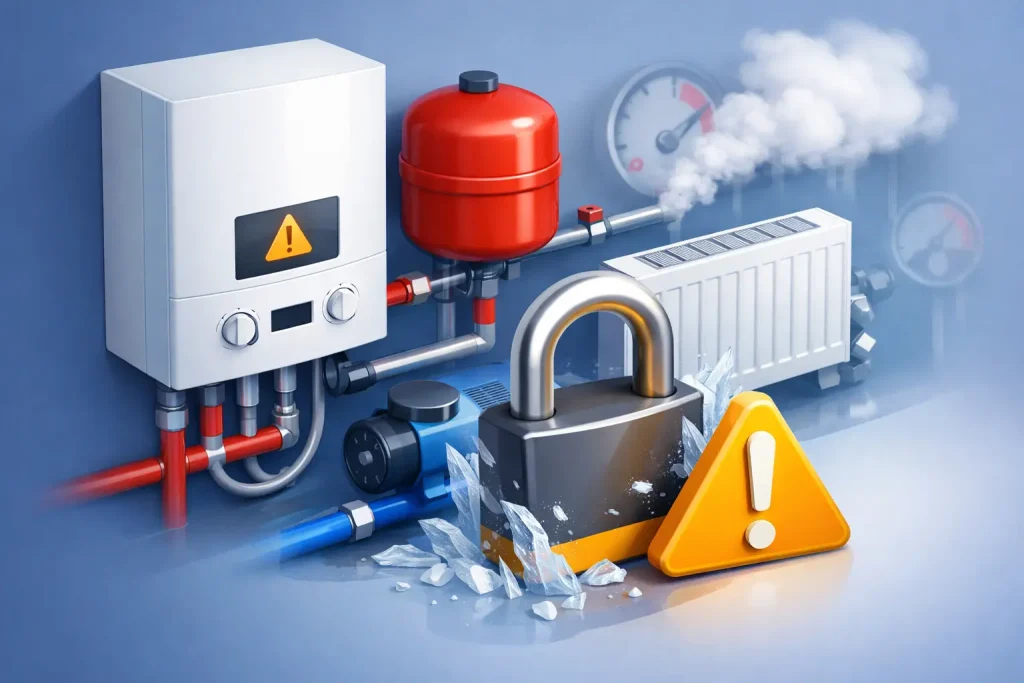
A boiler that runs for a few minutes, clicks off, and then refuses to restart is not being temperamental. It is protecting itself. If you are wondering why hydronic boiler keeps locking out, the short answer is that the control system has detected a fault condition and shut the appliance down before damage, unsafe combustion or overheating can occur.
That is the useful part of a lockout. The frustrating part is that several different faults can trigger it, and some are simple while others need immediate specialist attention. In a Melbourne winter, the difference matters. You do not want to replace a boiler on guesswork when the real issue is a failed sensor, poor circulation or an ignition component that can be repaired properly.
What boiler lockout actually means
Lockout is a safety response, not the fault itself. Modern hydronic boilers monitor water pressure, temperature rise, burner ignition, flame stability, fan operation and flue performance. If one of those readings falls outside the allowed range, the boiler shuts down and may display an error code or require a manual reset.
Some lockouts happen once and do not return for weeks. Others happen every time the system calls for heat. That pattern tells you a lot. An occasional lockout may point to an intermittent sensor fault or brief pressure drop. Repeated lockouts usually indicate a fault that will not resolve on its own.
Why hydronic boiler keeps locking out – the most common causes
The most common cause is low system pressure. Hydronic boilers need the right water pressure to circulate heat safely through radiators, towel rails or underfloor loops. If pressure drops too far, the boiler will lock out to prevent overheating and poor heat transfer. Low pressure can be caused by a small leak, a faulty filling loop, air in the system or an expansion vessel issue.
Circulation faults are another frequent trigger. If the pump is not moving water properly, heat builds up too quickly inside the heat exchanger. The boiler sees that rapid temperature rise and shuts itself down. In real homes, this can happen because of a seized pump, sludge in older pipework, stuck motorised valves or a blocked filter.
Ignition and flame detection faults are also high on the list. The boiler may be trying to fire but failing to prove flame. That can come from worn electrodes, a dirty burner, incorrect petrol pressure, a failing ignition lead or a flame sensor that is no longer reading reliably. The system locks out because unproven combustion is not something a modern boiler will allow.
Then there are flue and air intake problems. Condensing boilers depend on correct airflow and safe discharge of combustion gases. A blocked terminal, damaged flue component, fan fault or condensate issue can all interrupt that process. The boiler responds by shutting down.
Pressure problems are rarely just about topping up water
Homeowners are often told to repressurise and reset. Sometimes that works, but only as a short-term measure. If pressure keeps falling, there is a reason.
A visible leak is the obvious culprit, but not the only one. We often see very small leaks around radiator valves, automatic air vents, pressure relief discharge points or older boiler fittings. These can lose enough water over time to trigger recurring lockouts without leaving dramatic puddles.
The expansion vessel is another major suspect. If the vessel has lost its charge or the diaphragm has failed, pressure can swing sharply as the system heats and cools. That can cause nuisance lockouts, pressure relief valve discharge and inconsistent heating performance. Topping the system up without correcting the vessel fault only masks the issue briefly.
Overheating and poor circulation can look like a boiler fault
Sometimes the boiler is doing exactly what it should, but the wider system is causing the problem. Poor circulation is a classic example.
If radiators are cold at the bottom, slow to warm, or some rooms heat while others stay cool, sludge may be restricting flow. A blocked magnetic filter or partially closed valve can produce a similar effect. When the boiler cannot move heat away efficiently, internal temperatures rise too fast and lockout follows.
This is one reason specialist diagnosis matters. A general reset may get the appliance running for the moment, but if circulation remains poor, the boiler will continue protecting itself. In more severe cases, repeated overheating can shorten the life of pumps, seals and heat exchangers.
Why hydronic boiler keeps locking out after a reset
If the boiler restarts after you press reset but locks out again within minutes or hours, the fault is active. The reset has not fixed anything. It has only cleared the alarm long enough for the control board to test conditions again.
That distinction is important because repeated resets can waste time and, in some cases, make diagnosis harder. If the boiler lights briefly and then drops out, think ignition proving, flame stability, overheating or flue safety. If it will not even begin the start-up sequence, think pressure, control faults, fan issues or electrical supply problems.
The timing also matters. A lockout only during cold mornings may suggest a component beginning to fail under higher demand. A lockout after the boiler has been running for a while points more towards circulation, overheating or condensate drainage problems.
Condensate faults are more common than many homeowners expect
Condensing boilers produce condensate as part of normal high-efficiency operation. That water has to drain away correctly. If the condensate trap or pipework becomes blocked, frozen or incorrectly installed, the boiler can shut down.
This fault can be easy to miss because it does not always look dramatic. You may hear gurgling, notice inconsistent firing, or see a boiler lock out without an obvious leak. In winter, external condensate runs are particularly vulnerable if they are poorly routed or undersized.
The fix depends on the exact cause. A simple blockage is very different from a poorly designed discharge arrangement that needs correcting properly.
Electrical and sensor faults can be intermittent
Not every lockout comes from water, petrol or circulation. Boilers rely on a network of sensors and control components to make decisions. A temperature sensor reading incorrectly, a loose connection, a worn fan capacitor or a faulty printed circuit board can all create intermittent lockouts.
These faults are often the most misleading because the boiler may behave normally during part of the visit. That is where experience matters. Knowing what readings should look like under load, and having the right spare parts on hand, is often the difference between a first-visit repair and another cold night waiting for answers.
What you can check safely before booking a repair
There are only a few checks worth doing yourself. Look at the pressure gauge if your system has one and note whether it is unusually low. Check whether any radiators or valves are visibly leaking. See if the condensate pipe appears blocked or if there has been a recent cold snap. If the boiler displays an error code, write it down before you reset anything.
Beyond that, avoid guesswork. Do not keep repressurising the system without understanding why pressure has fallen. Do not continue resetting a boiler that is locking out repeatedly. And do not assume the appliance itself has failed beyond repair. Many lockout faults are repairable when diagnosed correctly.
When to call a hydronic specialist
If the lockout has happened more than once, if the pressure keeps dropping, if some emitters are cold while others heat normally, or if you can smell flue petrol or petrol, it is time to stop experimenting. A hydronic system is not just a boiler. It is a complete heating circuit, and lockouts often sit at the intersection of appliance controls and system conditions.
That is why homeowners with established or high-spec homes usually get better results from a genuine hydronic specialist rather than a generalist. Hydronic systems are all we do, and that matters when the real fault is not obvious at first glance. Repair-first diagnostics, stocked spare parts and tidy in-home service reduce downtime and avoid the all-too-common jump straight to replacement. If you need that level of support in Melbourne, Hydronix is built around exactly that outcome.
A boiler lockout is a warning, not a verdict. The right response is not to ignore it or panic-buy a new boiler, but to identify what the system is protecting itself from and fix that fault properly so your heat stays on when you need it most.