
You notice it first thing in the morning: the boiler sounds like it is working, the thermostat says “on”, but the radiators stay stubbornly lukewarm – or cold at the top and warm at the bottom. When hydronic radiators are not heating up, it is rarely “just one thing”. It is usually a flow problem, a control issue, or a boiler that is protecting itself.
This guide is written for homeowners who want heat restored quickly, without guesswork or unnecessary replacement. A few checks are safe to do yourself. Others are best left to a hydronic specialist with the right test gear, parts, and the experience to spot the real failure.
Hydronic radiators not heating up: what the symptoms tell you
Hydronic heating is simple in principle: a boiler heats water, a pump moves it, and radiators transfer that heat into the room. When the radiators are not heating up, pay attention to the pattern, because it narrows the fault fast.
If all radiators are cold, think “system-wide”: power, thermostat, boiler lockout, pump failure, or no system pressure. If one radiator is cold but others are fine, it is more likely air, a stuck valve, balancing, or sludge in that branch. If radiators are warm at the bottom but cold at the top, air is the usual suspect. If they are hot near the boiler and colder further away, you are often dealing with circulation problems, a tired pump, or poor balancing.
That distinction matters because it changes what you can reasonably check in five minutes, versus what needs professional diagnosis.
Safe checks you can do before you book a call-out
You do not need to be technical to do the basics. You do need to be methodical. Change one thing at a time, then re-check.
Check the thermostat and heating schedule
It sounds obvious, but it catches people out constantly. Confirm the thermostat is calling for heat and the setpoint is above room temperature. If you have zones, make sure the correct zone is selected. If the system is on a timer, confirm you are inside the heating window. If you recently had a power cut, some controllers revert to default programmes.
Confirm the boiler has power and is not in lockout
Look for any fault light or error code. Modern boilers will shut down to protect themselves if they detect ignition failure, overheat, low pressure, or flame issues. If the display is showing a code, do not clear it repeatedly and hope for the best – that can hide an intermittent fault. Make a note of the code for the technician.
Look at system pressure (where applicable)
Many sealed hydronic systems have a pressure gauge. If it is very low, water will not circulate properly and the boiler may refuse to fire. Low pressure usually means you have lost water somewhere, often via a small leak, a faulty pressure relief valve discharge, or air being bled out over time.
Topping up can be straightforward on some systems, but if pressure keeps dropping, the refill is not the fix – it is a clue. Repeatedly refilling introduces fresh oxygenated water, which accelerates corrosion and sludge formation.
Feel the pipes at the boiler or manifold
With the system calling for heat, carefully feel the flow and return pipes (they should be warm/hot if circulation is happening). If the boiler is hot but the pipes out to the system are not, it suggests the pump is not moving water, a motorised valve is shut, or there is a blockage. If both are warm but radiators stay cold, the issue may be local to the radiators (air, valves, balancing).
Check radiator valves are actually open
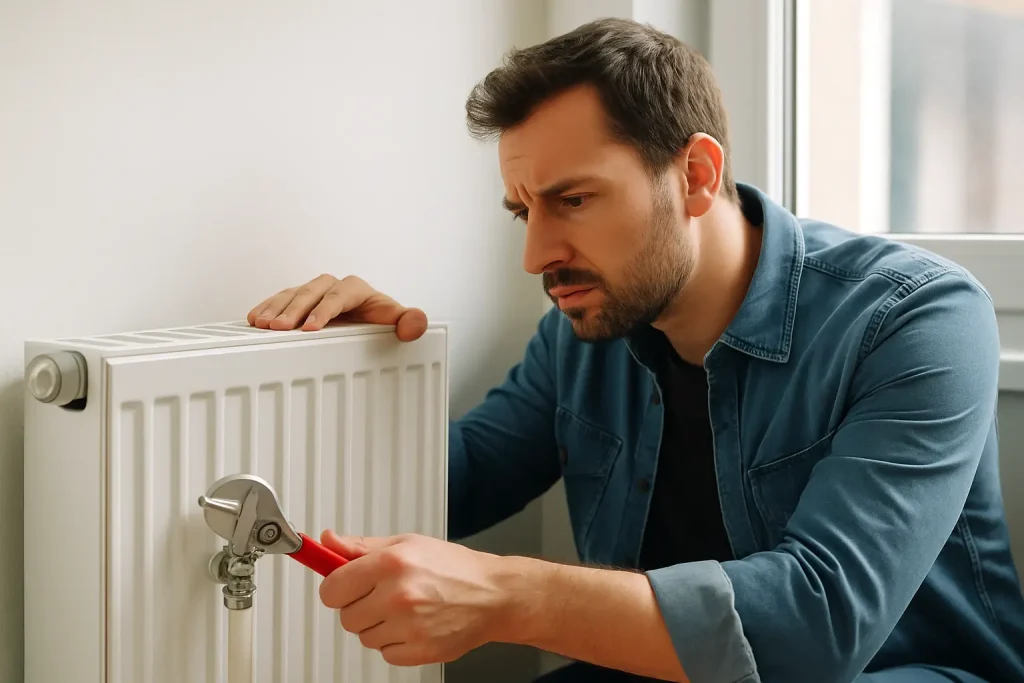
Thermostatic radiator valves can stick, particularly after summer when they have sat closed. If one radiator is cold, try turning the TRV fully open and make sure the lockshield valve is not shut. If you suspect a stuck pin in a TRV, resist the temptation to dismantle it if you are not confident – it is easy to create a leak.
The most common technical causes (and why they happen)
Once the obvious controls are ruled out, hydronic faults usually come down to circulation, air, contamination, or components failing under load.
Air trapped in radiators or pipework
Air is the classic reason for a radiator that is cold at the top. It also causes gurgling noises and uneven heat. Air gets in through micro-leaks, during maintenance, after draining down, or via failed air vents.
Bleeding a radiator can help, but if you are bleeding frequently, there is an underlying issue. A healthy system should not constantly accumulate air. Persistent air often links back to low pressure, a leak, or poor expansion vessel performance.
Circulation pump issues
If the pump is seized, worn, or incorrectly set, hot water will not reach the radiators properly. Pumps can also airlock. Sometimes the pump runs but cannot overcome system resistance if there is sludge or partially closed valves.
A key nuance here: a pump can “sound” like it is running and still be ineffective. This is why proper diagnostics involves temperature readings, pressure checks, and sometimes measuring the pump’s performance rather than relying on noise alone.
Motorised valves and zone controls
On zoned systems, a failed motorised valve can stop flow to a whole section of the home. You might have upstairs stone cold while downstairs is fine. Valves can fail electrically (head, microswitch) or mechanically (sticking). A valve that is half-open is particularly frustrating – you get some warmth, but never enough.
Sludge, magnetite, and blocked radiators
Older systems, and even some newer ones that were not flushed properly, can accumulate sludge. This reduces heat output and can leave radiators cold at the bottom, or cause some radiators to never fully heat. Sludge also damages pumps and heat exchangers over time.
A proper fix depends on severity. Sometimes a targeted powerflush and filtration is justified. Sometimes a radiator needs removal and clearing. Sometimes the best outcome is replacing a small number of radiators while protecting the rest of the system with a magnetic filter and inhibitor. It depends on the condition of the water, the pipework, and the boiler.
Boiler faults that mimic radiator problems
Ignition components, sensors, diverter valves (on combi-type arrangements), and heat exchangers can all reduce delivered heat even when the boiler appears to be operating. A boiler may fire but short-cycle, limiting how much heat gets into the system. If you are seeing intermittent warmth, frequent resets, or odd noises from the boiler, do not assume the radiators are the culprit.
When DIY stops being sensible
There is a line between safe observation and making the problem worse.
If you smell petrol, see signs of scorching, or suspect a flue issue, stop and arrange a qualified engineer immediately. If the system pressure is repeatedly dropping, treat it as a leak until proven otherwise – leaks can be hidden under floors or inside walls, and the damage can be expensive.
Equally, if you have bled radiators, confirmed controls, and you still have hydronic radiators not heating up, the next step is not random part swapping. The cost-effective approach is proper diagnostics: confirming boiler output, verifying pump operation, checking zone valve actuation, taking temperature differentials, and assessing water quality.
What a specialist will check on site (and what you get from it)
A good hydronic technician does not start with a new boiler quote. They start by proving where heat is being lost.
They will typically confirm the call for heat from the controls, check boiler status and fault history, and then work outward: pump operation, zone valves, flow and return temperatures, and system pressure behaviour while running. They will also assess radiator balance (especially in larger homes), because an unbalanced system can starve the last radiators on the circuit.
Water quality is often the deciding factor in recurring issues. If the water is dirty, black, or full of debris, that points towards cleaning, filtration, and inhibitor dosing – not just bleeding the same radiator every week.
If parts are needed, speed matters. The difference between “heat restored today” and “we will be back next week” is often whether the contractor carries the common pumps, valves, sensors, and seals required to complete the repair on the first visit.
Repair-first vs replacement: the decision points
Homeowners are often told the boiler is “old” and must be replaced the moment radiators go cold. Sometimes replacement is the right choice – but not as a reflex.
Repair-first is usually sensible when the fault is clearly identified (for example, a failed pump, motorised valve head, or pressure vessel issue) and the boiler is otherwise in decent condition. Replacement becomes more compelling when the heat exchanger is compromised, parts are obsolete, efficiency is poor, or the system has multiple interacting failures that keep returning.
If you are considering an upgrade, modern condensing boilers can reduce running costs and improve comfort consistency, but only when the system is cleaned, correctly sized, and properly commissioned. Fitting a new boiler onto a dirty system is how “new” turns into “still not right”.
For homeowners who want fast diagnostics and repair-first outcomes, Hydronix is built around that exact model – end-to-end hydronic work, specialist troubleshooting, and tidy in-home service – with bookings via https://hydronixheating.com.au.
How to avoid the same problem next winter
Hydronic systems reward preventative care. If your radiators struggled to heat this season, do not wait until the coldest week of the year to investigate.
A proper service is not a quick look at the boiler casing. It is checking combustion (where relevant), confirming safe operation, inspecting key wear components, verifying system pressure stability, and assessing water condition. If your system is prone to sludge, filtration and inhibitor maintenance are not optional extras – they are how you keep pumps, valves, and heat exchangers alive.
Balancing is another overlooked piece. Large homes with extensions or multiple storeys can drift out of balance over time, especially after radiator changes or plumbing works. Balanced correctly, the whole home heats evenly, the boiler runs more steadily, and you are less likely to get the “nearest radiators are roasting, furthest are cold” pattern.
The best time to fix reliability is when you are not under pressure. If you make one decision after reading this, make it this: treat cold radiators as a diagnostic problem, not a replacement trigger, and you will usually get warmer rooms, lower stress, and a system that behaves when winter properly arrives.