
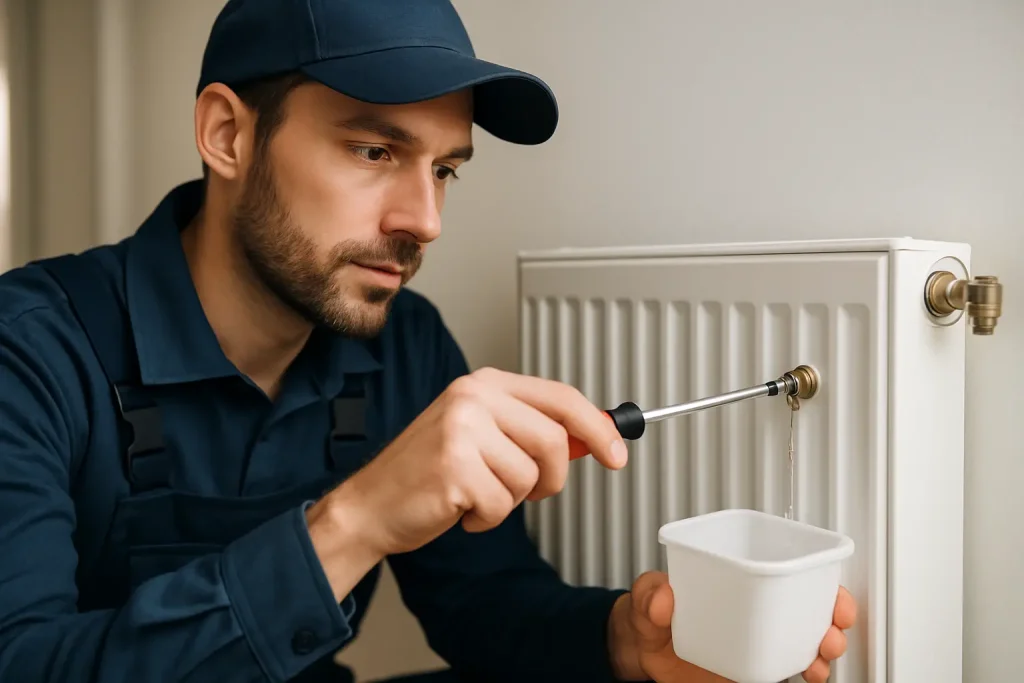
You know the feeling: the boiler sounds like it is working, the thermostat says “on”, and yet the radiator nearest the hallway is only warm at the bottom. Upstairs it is worse – one room is roasting, another is barely taking the edge off. If your hydronic system is otherwise healthy, trapped air is one of the most common reasons heat stops travelling properly.
A hydronic radiator bleeding service is exactly what it sounds like – a professional visit to remove air from radiators (and sometimes from high points in pipework), then bring the system back to stable pressure and balanced performance. Done properly, bleeding is not just cracking a valve for a few seconds. It is a small diagnostic job that can quickly reveal bigger issues like leaks, failing expansion vessels, poor pump performance, sludge build-up, or a boiler that is short-cycling.
What radiator bleeding actually fixes (and what it does not)
Air in a closed-loop hydronic system behaves like a blockage. Water can only carry heat where it can circulate, and air pockets interrupt that circulation. The result is the classic “hot at the bottom, cold at the top” radiator, gurgling noises, or radiators that take far longer than they used to.
Bleeding fixes problems caused by trapped air. It does not fix root causes that keep introducing air in the first place. If you bleed your radiators and the issue returns in days or weeks, that is a signal. Something is letting air in or allowing pressure to drop, and repeated bleeding becomes a bandage rather than a repair.
It also does not magically clear sludge. Sludge can mimic air problems because it restricts flow and leaves parts of the radiator cold. A good service tech will differentiate between the two before they promise quick wins.
Signs you are due for a hydronic radiator bleeding service
Most homeowners book bleeding after comfort drops off, but there are earlier cues worth paying attention to.
If you hear gurgling, bubbling, or a “trickling” sound when the heating starts, that is often air moving through the radiator. If certain radiators need the thermostat higher than usual to feel warm, or if some rooms heat up while others lag behind, you may have a mix of air pockets and balancing issues. A radiator that stays cold at the top even when valves are open is the obvious one.
Keep an eye on pressure as well. If your boiler pressure gauge regularly falls and you top it up often, that is not normal. Yes, systems can need an occasional top-up after maintenance, but frequent topping up suggests a leak or a fault with the expansion vessel or pressure relief valve. Every time you introduce fresh water, you also introduce dissolved oxygen – and that feeds corrosion and makes future air issues more likely.
Why air gets into a “sealed” hydronic system
Homeowners are often told hydronic heating is sealed. In practice, it is “closed loop”, but it still has components and conditions that can allow air to appear.
Fresh water additions are a big one. Any top-up brings in oxygen that can come out of solution once heated. Microbubbles can then collect at high points, especially in tall homes or where pipework rises and falls.
Small leaks can also pull air into the system as it cools and pressure drops. This can be subtle – a valve spindle weeping, a pinhole in a hidden run, or a radiator tail that has been knocked during renovations.
A failing expansion vessel is another repeat offender. When it loses its air charge or the diaphragm fails, system pressure swings more dramatically between cold and hot. That can trigger the pressure relief valve, dump water, and set off a cycle of topping up and reintroducing oxygen.
What a professional bleeding service looks like
A proper hydronic radiator bleeding service should feel like a controlled, tidy process, not a rushed “open a key and hope”. There is a right order, and there are checks that protect your boiler and pipework.
1) Quick system health check before touching valves
Before bleeding begins, a technician should look at boiler pressure (cold and ideally hot), confirm the type of system, and note any obvious corrosion marks, staining around valves, or signs of previous leaks. They should also ask how often you have needed to top up, and whether any recent work has been done.
This matters because bleeding releases air, but it also releases a small amount of water and can lower system pressure. If the system is already borderline low, bleeding without a plan can leave you with radiators full of air again and a boiler that locks out on low pressure.
2) Bleeding in the correct sequence
Air rises. That means the highest radiators and high points tend to hold the most. In many homes, the top floor radiators are bled first, then the lower floors. The technician will work methodically, opening each bleed point until air stops and water flows cleanly.
Done properly, this is not messy. A cloth and a controlled container prevent staining on carpets, and the bleed is closed firmly without over-tightening (which can damage the valve).
3) Restoring and stabilising system pressure
After bleeding, system pressure must be brought back to the correct range for your boiler and property height. Too low and circulation suffers. Too high and you risk discharge through the relief valve and premature component wear.
A careful technician will top up in a controlled way, then recheck pressure once the system has run and warmed. Pressure rises with temperature. The goal is stability, not a random number.
4) Verifying circulation and balancing where needed
Bleeding removes air, but it does not guarantee even heat distribution. If some radiators still underperform, the tech should check circulation and consider balancing adjustments so each radiator receives an appropriate share of flow.
Balancing is not always necessary after a simple bleed, but in larger or older homes it is often the difference between “it works” and “every room heats predictably”.
DIY bleeding vs calling a specialist: where the line is
If you have one radiator that is mildly cold at the top, your boiler pressure is stable, and you are comfortable topping up pressure correctly afterwards, you may be able to bleed it yourself.
The line is crossed when any of the following are true: pressure keeps dropping, you are bleeding radiators regularly, multiple radiators are affected, you have a tall home with complex pipe runs, or you suspect sludge (radiator cold in the middle or bottom, or poor heat even after bleeding). Another trigger is any sign of water around valves, the boiler, or the pressure relief discharge point.
The risk with DIY is not the act of bleeding itself. The risk is missing what the air is telling you. Air that keeps coming back is usually a symptom, not the problem.
How long it takes and what it typically costs
Time depends on the number of radiators and access. A smaller home might be handled quickly; a larger property with multiple levels, towel rails, and hard-to-reach bleed points takes longer.
Cost depends on the same factors, plus whether the visit becomes a diagnostic and repair. If the tech finds a leaking valve, a failed air vent, or a pressure issue linked to an expansion vessel, the scope changes from “bleed” to “fix”. That is not upselling when it is real – it is how you avoid paying for repeat call-outs.
If you want predictability, ask for a clear onsite process: confirm symptoms, bleed and stabilise, then advise what is required if pressure loss or recurring air is found.
When bleeding is the wrong solution
There are scenarios where bleeding gives a short-lived improvement or none at all.
If radiators are cold but the pipework feeding them is also cold, you may have pump issues, a stuck zone valve, or control problems. If only one side of a radiator warms, you might be looking at a partially closed lockshield or a blockage. If the boiler is short-cycling, you may not be getting sustained flow long enough to heat the system. And if you have heavy sludge, the fix is usually cleaning and protection, not repeated bleeding.
A reliable contractor will say “this is not a bleeding problem” when that is the truth, then explain the next step in plain terms.
Booking the service: what to ask so you get a real fix
When you book a hydronic radiator bleeding service, ask whether the technician will check system pressure and look for the cause of recurring air. Ask how they handle top-ups and whether they will run the system afterwards to confirm stable operation.
It is also worth mentioning anything that helps diagnosis: how often pressure drops, which radiators are affected, whether noises happen at start-up or continuously, and whether you have had recent building works. Small details can cut time on site and get you to the real fix faster.
For homeowners who want a repair-first specialist rather than a replace-first sales pitch, Hydronix is a Melbourne-based hydronic heating contractor that focuses on fast diagnostics and first-visit repairs where possible – details and booking are at radiator and leak repairs.
The comfort payoff: what “fixed” should feel like
After a proper bleed and stabilisation, radiators should heat evenly across their surface, start warming within a predictable timeframe, and stop making noise. More importantly, the boiler should run more smoothly because it is not fighting air pockets that interrupt flow.
If you have been living with uneven rooms, you will notice it immediately: you stop chasing the thermostat, doors can stay open without creating cold zones, and the whole system feels calmer.
The most helpful way to think about bleeding is this: it is not a chore to repeat forever. It is a diagnostic moment. If air has built up once, it may have a straightforward cause – or it may be your system asking for attention before a small fault becomes a winter breakdown. Keep that mindset, and you will stay warm with fewer surprises.