
If you have ever walked from a warm living room into a bedroom that feels two degrees colder, you already know the problem with many heating systems. They heat a house, but not always comfortably. That is why the choice between hydronic and ducted heating matters so much, especially in Melbourne homes where winter comfort needs to be dependable, not patchy.
For homeowners weighing hydronic heating vs ducted heating, the right answer depends on the house, the way you live in it, and whether you value fast blasts of warm air or steady, even heat that lasts.
Hydronic heating vs ducted heating at a glance
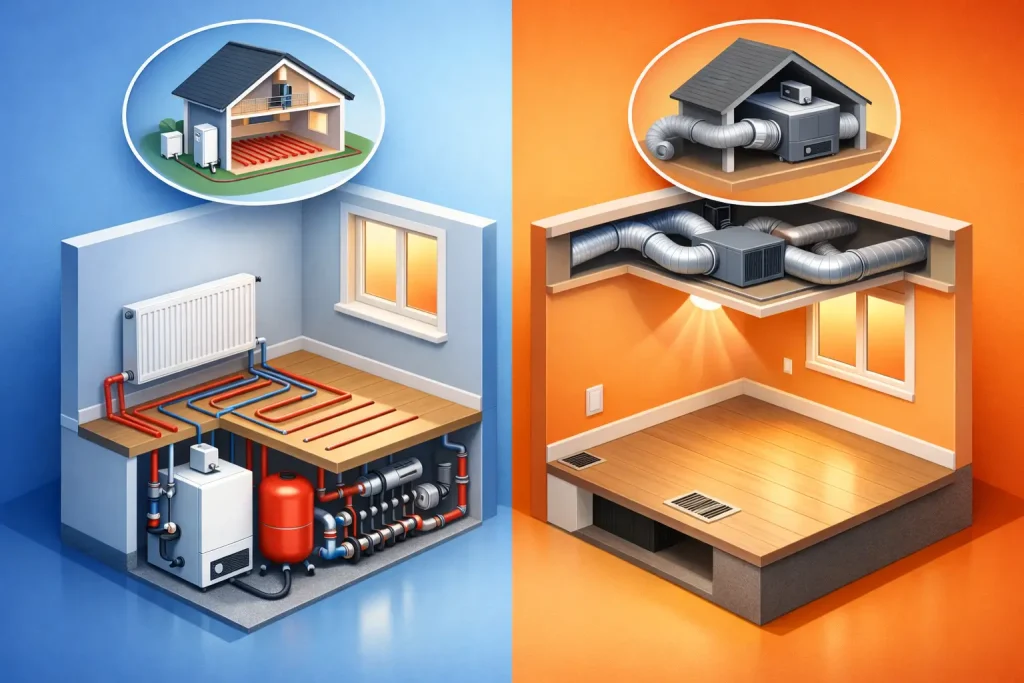
Hydronic heating warms your home by circulating heated water through radiators, towel rails or in-slab pipework. The heat is radiant and gentle. It does not rely on pushing air around the house.
Ducted heating uses a central unit to heat air, then distributes that air through ducts and vents into different rooms. It can warm a space quickly, and it is familiar to many households because it is common in newer homes and volume builds.
On paper, both systems heat a home. In practice, they feel very different to live with. That difference is usually what decides the outcome.
The biggest difference is comfort
Comfort is where hydronic usually pulls ahead. Radiators and hydronic panels deliver an even, stable warmth that builds gradually and holds well. Rooms feel consistently warm rather than briefly hot and then cool again once the system cycles off.
Ducted heating tends to be more immediate. You turn it on, warm air comes through the vents, and the room heats up quickly. That speed appeals to some households. The trade-off is that forced air can create temperature swings, particularly in homes with poor insulation, high ceilings or leaky ductwork.
For families who are home through the evening and want a house that stays comfortable without that dry, blown-air feel, hydronic heating is often the better fit. For households that want short bursts of heat at set times, ducted can still make sense.
Running costs depend on more than the unit
A lot of people ask which is cheaper to run. The honest answer is that it depends on the system design, the boiler or heater efficiency, zoning, insulation and how the home is used.
Hydronic systems paired with modern condensing boilers can be very efficient, particularly when sized correctly and maintained properly. Because the heat is stable and targeted, many homeowners find they can stay comfortable without pushing the system hard. Zoned hydronic setups also let you heat occupied areas rather than the whole house.
Ducted petrol heating can be economical in some homes, but running costs often rise when the system is heating unused rooms, losing heat through ducts in roof spaces, or cycling frequently to maintain temperature. Older ducted units can be especially expensive if they are inefficient or poorly controlled.
This is where good advice matters. A cheap install that is oversized, under-zoned or poorly commissioned can cost more over time than a premium system set up properly from day one.
Air quality and dust are not a small issue
This point gets overlooked until someone in the home has allergies, asthma or simply gets tired of warm air carrying dust around the house.
Hydronic heating does not blow air. That means no moving dust through vents, no dry air sensation caused by forced circulation, and no fan noise in the background. In established homes, particularly where occupants are sensitive to dust, this can be a major advantage.
Ducted heating, by design, moves air. Filters and maintenance help, but it still circulates air through the duct network and into rooms. Some people are perfectly happy with that. Others notice the difference straight away and never really warm to it.
If indoor air comfort matters as much as temperature, hydronic is hard to beat.
Installation: the house usually decides first
When comparing hydronic heating vs ducted heating, installation practicality often narrows the choice quickly.
Ducted heating generally suits homes with enough roof or underfloor space for ducts, and where vents can be installed without major disruption. In some properties, especially newer builds, it is a straightforward option.
Hydronic heating is flexible, but the type of system matters. Panel radiators work well in many renovation and retrofit situations because pipework can often be routed with less structural disruption than full duct runs. In-slab hydronic heating is excellent for new builds and major renovations, but it is not usually something you add casually after the house is finished.
Older Melbourne homes often favour hydronic radiators because they suit the layout, preserve the feel of the home and avoid the bulk of ductwork. In premium homes where finishes matter, that can be a decisive factor.
Noise, aesthetics and day-to-day living
A heating system is not just a piece of plant. You live with it every winter, so the small details matter.
Hydronic systems are quiet. You are not listening to fans starting up, air rushing through vents or duct expansion noises in the ceiling. The heat arrives without much fuss.
Ducted heating is not necessarily loud, but it is usually more noticeable. Some households do not mind that at all. Others find it intrusive, especially at night or in quieter homes.
Aesthetically, hydronic radiators are visible, which some people like and others do not. Ducted vents are less visually dominant in the room itself, but the hidden system still needs space above or below the house. Neither is universally better. It comes down to whether you would rather see a well-placed radiator or design around vents and duct routes.
Maintenance and long-term reliability
All heating systems need maintenance if you expect them to perform properly. The difference is in how faults present and how they are resolved.
Hydronic systems are highly durable when designed and installed well. Boilers, pumps, valves and radiators all need periodic servicing, but the systems themselves are known for longevity. Importantly, many faults are repairable without replacing the whole setup. That matters if you already have hydronic and want to protect the investment rather than start again.
Ducted systems also require servicing, particularly burners, fans, controls and duct integrity. Leaks, airflow imbalance and ageing components can all affect performance. In some cases, the issue is not the central heater at all but the duct network around it.
For homeowners who value repair-first thinking, hydronic has a strong case because components can often be diagnosed and repaired in a targeted way. Specialists who work on these systems every day can usually tell the difference between a part failure and a system that genuinely needs upgrading.
Which system suits which home?
Hydronic heating tends to suit homeowners who want premium comfort, quiet operation, better air quality and long-term efficiency. It is especially well suited to established homes, high-end renovations and households that use heating for longer periods rather than quick bursts.
Ducted heating tends to suit homeowners who want rapid warm-up, already have suitable duct space, or prefer a familiar whole-home forced-air system. It can work well in homes where the layout and usage pattern favour shorter heating periods.
The wrong approach is choosing on headline price alone. The better approach is looking at the total picture – installation method, comfort expectations, running costs and how easily the system can be maintained over time.
A practical way to choose
If you are building or renovating, ask how the system will actually perform in your rooms, not just what unit is being quoted. Ask about zoning, controls, insulation assumptions and what happens if a component fails five years from now.
If you already have hydronic heating and it is underperforming, do not assume replacement is the only answer. In many cases, poor heat output, boiler faults, cold radiators or uneven performance can be corrected with proper diagnostics and repair. That is often faster and far more cost-effective than ripping out a system that still has good life in it.
For Melbourne homeowners who want steady warmth, low-noise comfort and a system built around the way people actually live at home, hydronic remains the stronger option more often than not. It asks for the right design and the right specialist, but it pays that back in day-to-day comfort.
If you are choosing between the two, choose the system you will still be happy living with in the middle of July, not just the one that looks simplest on a quote.