
A boiler that fires properly but leaves radiators patchy, slow to warm, or cold at the bottom usually has a circulation problem, not an instant replacement problem. That is where a hydronic heating system power flushing guide becomes useful. If sludge, magnetite and old system debris are restricting flow, a proper flush can restore performance, reduce strain on the boiler and bring heat back more evenly across the home.
Power flushing is not a magic fix for every hydronic fault. It is a targeted cleaning process used to remove built-up contamination from pipework, radiators, valves and heat exchangers. Done at the right time, it can improve heat output and system efficiency. Done carelessly, especially on older systems with hidden weaknesses, it can expose leaks or disturb components that were already close to failure.
What power flushing actually does
In a hydronic heating system, water should circulate cleanly and consistently. Over time, oxygen ingress, corrosion and general wear create sludge and fine black magnetite. That material settles in low points, coats internal surfaces and restricts flow through radiators, manifolds and narrow boiler passages.
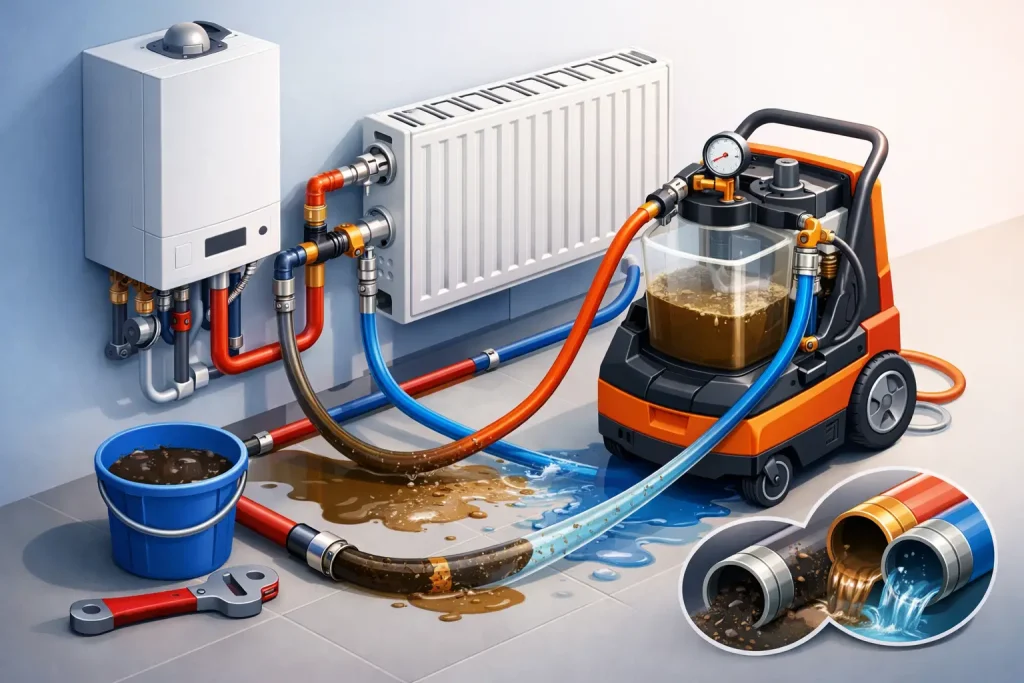
A power flush uses a specialist pump to move water and cleaning chemicals through the system at controlled velocity. The aim is to break up and remove debris without damaging the installation. Clean water is then introduced until discharge runs clear, and the system is treated with inhibitor to slow future corrosion.
This is not the same as simply draining the system and refilling it. A basic drain-down removes some dirty water. It does very little for settled sludge stuck in radiators or lodged in tight sections of pipework.
Signs your system may need a hydronic heating system power flush
The most common warning sign is uneven heating. One radiator may be hot at the top and cold at the bottom. Another may stay lukewarm even when the thermostat is calling for heat. In underfloor hydronic systems, some zones may feel noticeably weaker than others.
You may also hear circulation noise. Gurgling, kettling or pump strain can all point to contamination affecting flow. Dirty system water is another clue. If a technician draws off water and it appears black or heavily discoloured, corrosion products are already circulating through the system.
Some households notice a gradual rise in running costs before they notice comfort issues. When debris reduces heat transfer and circulation, the boiler has to work harder and longer to achieve the same indoor temperature. That does not always mean power flushing is the answer, but it is a common part of the diagnosis.
When power flushing makes sense
Power flushing is most useful when the system is structurally sound but suffering from contamination. That includes radiators with cold spots, repeated blockages, poor circulation after years without maintenance, or older systems being paired with a new boiler where clean water quality matters.
It can also be worthwhile before condemning major components. We fix systems others replace, and that approach matters here. A boiler fault code, noisy pump or weak heat output can sometimes be a symptom of poor system water rather than failed equipment. Cleaning the system may restore normal operation or at least allow accurate diagnosis.
There are also cases where a lighter-touch clean is more appropriate. On fragile older pipework, a chemical cleanse and careful circulation may be safer than an aggressive flush. The right method depends on the system condition, age, materials and existing faults.
When power flushing is the wrong call
A good hydronic heating system power flushing guide should be clear about limits. If the boiler has an electrical fault, failed fan, damaged expansion vessel, leaking heat exchanger or ignition issue, flushing will not solve it. If a motorised valve has failed mechanically or controls are not calling correctly, the problem lies elsewhere.
It can also be the wrong starting point for a system with obvious active leaks or badly deteriorated components. In those cases, the first job is to stabilise the system. Forcing higher flow through compromised pipework or old radiator sections can reveal weaknesses that were already there.
This is why proper pre-checks matter. A specialist should assess pressure stability, visible corrosion, valve condition, pump operation and overall system design before deciding on the cleaning method.
How the process should work
A professional power flush starts with diagnosis, not equipment set-up. The engineer should confirm what symptoms you are seeing, test heat distribution, inspect the boiler and pump, and check whether the system is suitable for flushing.
The flushing pump is then connected to the system, often at a strategic point that allows good circulation through all emitters and circuits. Cleaning chemicals are introduced, and individual radiators or zones may be isolated and worked through one by one. Agitation tools can help dislodge compacted sludge in stubborn areas.
Throughout the process, water quality is monitored. The engineer may reverse flow, pulse sections of the system and repeatedly discharge dirty water until contamination levels drop. Once the clean is complete, the system is refilled, dosed with inhibitor and recommissioned.
At that stage, performance should be checked properly. Radiators should heat more evenly, circulation noise may reduce and the boiler should run under cleaner conditions. If any components were already marginal, the flush can also make those issues easier to identify accurately.
Risks homeowners should know about
The biggest risk is not power flushing itself. It is applying it to the wrong system or doing it too aggressively. Older hydronic installations can contain ageing valves, delicate seals and pipework that has not been touched in years. If those parts are already at the end of their life, cleaning may expose rather than create the weakness.
That does not mean the flush caused the problem in the true sense. It usually means the system had hidden deterioration that was masking itself behind sludge deposits. Still, for homeowners, the distinction matters less than the outcome. You need to know the risk before work starts.
There is also a quality risk. A rushed contractor may flush the main loop but fail to clean every radiator or zone thoroughly. They may skip inhibitor, leave air in the system or fail to rebalance the heat distribution afterwards. The result is a bill paid without the full benefit.
How to tell if your system needs a specialist, not a general plumber
Hydronic systems are all we do. That kind of specialist focus matters because power flushing sits at the intersection of water quality, heat transfer, controls and mechanical condition. A general plumbing approach can miss the root cause.
A proper hydronic specialist does not assume every cold radiator needs flushing. They test. They check whether the pump is moving water correctly, whether valves are opening, whether the boiler is modulating as it should and whether the issue is localised or system-wide. That protects you from paying for the wrong work.
For homes with premium finishes, there is also the service side. Clean set-up, tidy hose management, careful handling around flooring and a clear explanation of findings are not extras. They are part of professional in-home work.
What results you can realistically expect
If sludge is the main problem, power flushing can deliver a noticeable improvement. Rooms heat faster. Radiators warm more evenly. Boiler noise may reduce, and circulation becomes more consistent. In some systems, energy use improves because the boiler no longer has to push through restricted flow paths.
But expectations should stay realistic. A flush will not turn an undersized system into a perfect one. It will not correct poor original design, failing controls or a boiler that is simply at the end of its service life. Sometimes the right outcome is a flush plus targeted repairs, such as a new pump, valve replacement or magnetic filtration.
That is often the best-value path. Repair first where sensible, replace only when necessary.
Before you book a power flush
Ask what evidence supports the recommendation. Are there cold spots, dirty water samples, circulation issues or recurring boiler faults linked to system contamination? Ask how the system will be protected afterwards, because inhibitor and ongoing maintenance are part of the job, not optional extras.
It is also reasonable to ask what happens if weak components are uncovered during the process. A specialist should be upfront about that possibility and able to deal with common repairs without turning a one-day job into a drawn-out problem.
If your hydronic heating has become unreliable, the right question is not simply whether to flush. It is whether the system has been diagnosed properly. When that happens, power flushing can be a very effective tool rather than an expensive guess. Warmth should be restored by evidence, not assumption.