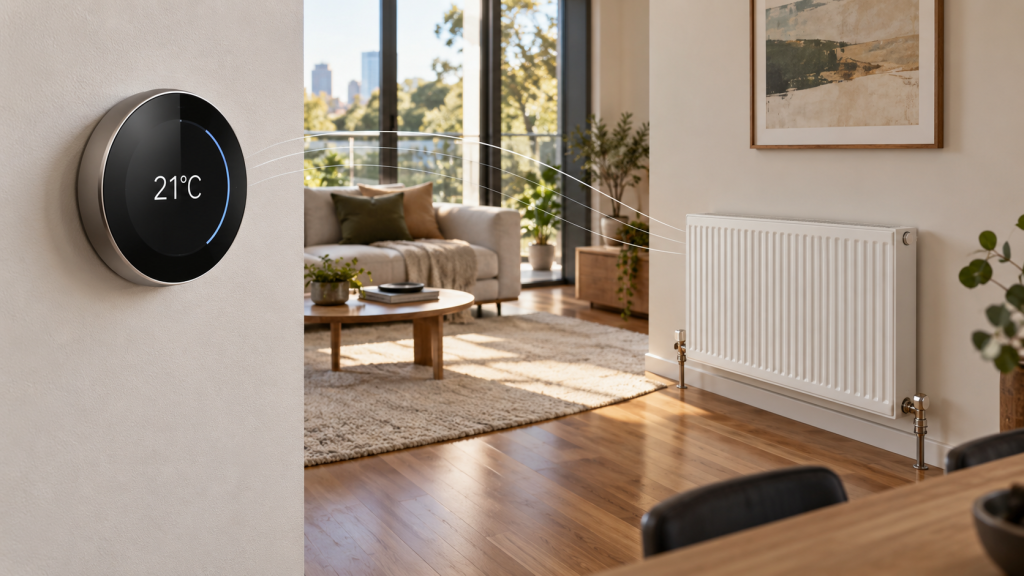
If your hydronic heating keeps the house comfortable but the controls feel dated, you are not alone. Many Melbourne homes have excellent boilers, radiators and pipework sitting behind a thermostat that does little more than switch the system on and off. Smart thermostats for hydronic heating can be a worthwhile upgrade, but only when the controls suit the way your system actually runs.
That distinction matters. Hydronic heating is not the same as ducted air. It warms more gradually, holds heat longer and often relies on a boiler, pump, zone valves and room-by-room balancing all working together. A smart control can improve comfort and lower wasted energy, but the wrong one can create short cycling, poor zoning, uneven temperatures or a boiler that never performs as efficiently as it should.
Are smart thermostats for hydronic heating worth it?
In the right system, yes. A good smart thermostat gives you better scheduling, more consistent room temperatures and more control over when the boiler runs. For households with changing routines, that can mean less heating an empty house and fewer mornings waking up to cold rooms.
The value is usually not in the novelty of controlling heating from your phone. It is in matching heat delivery to real occupancy. If your family leaves early, returns late and uses only certain parts of the home during the day, a smarter control strategy can reduce wasted run time without sacrificing comfort.
But there is a trade-off. Hydronic systems respond more slowly than forced-air systems, so aggressive setback schedules do not always deliver the savings people expect. If you let the house cool too much overnight, the boiler may need to run hard for longer in the morning to recover. In well-built homes, gentle temperature adjustments often work better than dramatic swings.
Why hydronic heating needs the right control logic
A hydronic system is only as good as its control strategy. The thermostat is not working in isolation. It is telling a boiler and often several other components what to do, when to do it and for how long.
In a simple single-zone system, the thermostat may just call for heat and allow the boiler and pump to do the rest. In a zoned home, one thermostat might open a valve for upstairs radiators while another calls for slab heating downstairs. In more advanced systems, boiler modulation, outdoor sensors and flow temperature control also come into play.
That is why a thermostat that works brilliantly in one home can be a poor fit in another. Some smart thermostats are designed mainly for forced-air systems and have limited compatibility with boilers. Others can control hydronic heat well, but only if the wiring, relays and zoning components are configured properly.
If your current heating suffers from cold radiators, random boiler lockouts, noisy pipework or rooms that overshoot temperature, a new thermostat may not be the fix. Controls can improve a healthy system. They do not replace proper diagnostics.
What a smart thermostat can improve
The first benefit is convenience, but convenience is only useful when it supports better system behaviour. A smart thermostat can let you programme heating around real routines instead of fixed old-school time blocks. That matters for busy households where no two weekdays look quite the same.
It can also improve consistency. Traditional thermostats often allow larger temperature drift before they call for heat. Better controls can tighten that range, so your living spaces feel more even through the day.
In some setups, smart controls also support zoning more effectively. If different parts of the house are occupied at different times, separate zone control can avoid overheating unused rooms. That is particularly helpful in larger period homes and multi-storey properties where heat demand varies a lot.
The final gain is visibility. Usage data, schedules and room temperatures can show how the system behaves over time. That can be useful when diagnosing whether the issue is poor control, an underperforming boiler or a balancing problem in the hydronic circuit.
Where smart thermostats for hydronic heating go wrong
The most common problem is assuming every smart thermostat is boiler-friendly. It is not. Compatibility depends on the boiler type, whether the system uses on-off or modulating control, how many zones you have and what wiring is already in place.
The second problem is poor installation planning. We regularly see controls fitted without properly checking relay requirements, sensor location or the way the system stages heat. The result can be a boiler that fires too often in short bursts, reducing efficiency and increasing wear.
There is also the issue of thermostat placement. Put a sensor in a hallway, near direct sun or beside a radiator, and it can make bad decisions for the whole house. The system then appears unreliable when the real problem is that the control is reading the wrong conditions.
Then there is floor heating. Hydronic slab systems behave very differently from panel radiators. A slab has significant thermal mass and responds slowly. Smart recovery features that work well with radiators can overshoot badly with underfloor heating if not set up correctly. In these homes, patient control logic matters more than flashy app features.
How to choose the right thermostat for your system
Start with the boiler. The first question is not which app looks best, but how the thermostat will communicate with the heat source. If your boiler supports modulation, it makes sense to use controls that can take advantage of that rather than reducing everything to simple on-off calls for heat.
Next, look at zoning. A single-zone weatherboard home has very different control needs from a large house with separate radiator circuits, towel rails and underfloor loops. If the home has multiple zones, the thermostat needs to integrate with valves, actuators or a control panel that can manage them properly.
Then consider the way you live in the home. Some families want steady background warmth all winter. Others want clear day and night scheduling. There is no universal best setting. Good control should reflect how the household uses rooms, not force everyone into a rigid heating pattern.
Finally, think beyond the thermostat itself. If the system is overdue for a boiler service, has sludge in the pipework or suffers from circulation issues, sorting those fundamentals first will deliver a better result than adding smart controls on top of hidden faults.
A practical approach before you upgrade
Before fitting a smart thermostat, check whether the system is already performing as it should. Are all radiators heating evenly? Does the boiler fire and modulate correctly? Are there known leaks, pressure drops or air issues in the circuit? If the answer is no, fix those first.
Once the system is healthy, the next step is to map the controls. That means understanding how many zones exist, what each thermostat currently does, what boiler interface is available and whether the control wiring supports the upgrade. This is where specialist hydronic knowledge matters. A general electrical or plumbing approach can miss boiler-specific control requirements.
For some homes, the best answer is a full smart thermostat upgrade. For others, it may be a more targeted change such as replacing an outdated controller, improving zoning or pairing smarter scheduling with a condensing boiler setup. Hydronix works on this principle every day – repair and optimise what is there where possible, rather than pushing replacement where it is not needed.
When a thermostat upgrade pairs well with a boiler upgrade
Smart controls tend to deliver the best results when the rest of the heating plant is ready to support them. If you are already planning a condensing boiler upgrade, it makes sense to assess the controls at the same time.
Modern boilers can operate far more efficiently when they are not being driven by crude stop-start control. Better thermostat logic, correct zoning and sensible temperature settings can help the boiler run in a steadier, more efficient way. That is good for comfort and good for long-term operating costs.
Still, more technology does not always mean a better outcome. The right setup is the one that your household can use easily, that your system can support reliably and that does not introduce new points of failure just for the sake of features.
The real question to ask
The best question is not, “What is the smartest thermostat on the market?” It is, “What control setup will make this hydronic system heat the house more reliably and efficiently?” That shifts the focus from gadgets to performance.
If your current controls are basic, a well-chosen smart thermostat can absolutely improve comfort. If the system has deeper faults, the thermostat should come after proper diagnosis, not before. Hydronic systems are all about how the parts work together.
A good upgrade should leave you with something simple: the house warms when it should, the temperature stays steady, and winter feels easier to manage.