

A hydronic leak rarely starts with water on the floor. More often, it shows up as a boiler that keeps losing pressure, a radiator that needs bleeding again, or one room that never quite warms up like the rest. If you are wondering how to find hydronic heating leaks, the goal is not to guess. It is to narrow the fault down quickly, protect the home, and avoid replacing parts that are not actually the problem.
Hydronic systems are closed systems. Once filled and operating correctly, they should not be regularly taking on fresh water or dropping pressure for no reason. A small leak can sit unnoticed for weeks, especially if it is under the floor, inside a wall cavity, or evaporating off hot pipework before it leaves a visible mark. That is why the best leak checks start with system behaviour, not just what you can see.
How to find hydronic heating leaks without guessing
Start with the pressure gauge at the boiler. In many homes, the first clue is a pressure reading that gradually falls between top-ups. If the system pressure drops when the heating is off and continues doing so over several days, that usually points to water leaving the system somewhere. If the pressure rises sharply when the boiler fires and then discharges water through a relief pipe, the issue may be an expansion vessel fault rather than a pipe leak. The distinction matters, because both problems can look similar from the homeowner’s point of view.
Next, check whether the leak appears only when the system is hot. Some joints stay dry when cold and open slightly as pipework expands. Others leak continuously but so slowly that the water never travels far enough to become obvious. A proper diagnosis often means observing the system in both conditions.
Before touching anything, switch off electrical controls if there is active dripping near the boiler or wiring. Place towels or a tray under visible drips, and avoid over-tightening valves or fittings. A small seep can become a larger failure very quickly if the wrong part is forced.
The most common places hydronic leaks start
In residential systems, leaks often occur at radiator valves, automatic air vents, pump unions, boiler isolation fittings, pressure relief valves and ageing compression joints. These are the points where seals, threads and moving parts do the hardest work. In older homes, we also see corrosion at steel components and slow leaks at mixed-metal connections where the system water quality has not been well maintained.
Radiators deserve a close look. Check around the valve spindle, the tail where the valve enters the radiator, the bleed point, and the underside of the panel. Water can run along the bottom edge and collect somewhere that makes the source easy to misread. Timber floors and skirting can also wick moisture away from the leak point, so damage may appear beside the radiator rather than directly beneath it.
At the boiler, inspect beneath the casing area for staining, rust marks or dried mineral deposits. You may also notice green or white residue on brass fittings where water has been evaporating for some time. If there is copper pipework nearby, look for darkened patches or old drip trails. A relief valve discharge pipe outside the home can also tell a story. If it is regularly wet or leaves staining below the outlet, the system may be shedding water there rather than through a visible indoor leak.
Signs a leak is hidden in pipework
Hidden leaks are the ones that waste the most time when handled by trial and error. If your boiler pressure keeps falling but exposed valves and radiators look dry, the fault may be under the floor, in wall chases, or within a slab circuit.
There are usually secondary signs. You might notice a musty smell, localised floor movement, patchy warmth where there should not be any, or unexplained marks on plaster. On suspended timber floors, one section may feel warmer because leaking heated water is trapped below. On slab systems, the leak may show as an odd warm patch that lingers after the heating cycle ends.
It depends on the construction of the home. In some properties, leaking water travels a long way before surfacing. In others, insulation and flooring trap it so effectively that the only obvious symptom is repeated pressure loss. That is why a visual check alone is not enough for concealed pipework.
A simple homeowner check before calling a specialist
If the system has a filling loop or top-up arrangement, note the current pressure, then leave the heating off for several hours and recheck it. After that, run the system up to temperature and monitor the gauge again. A drop in both hot and cold conditions suggests an external leak or discharge problem. A sharp rise when hot followed by pressure loss can point to expansion issues, which are common and often mistaken for pipe leaks.
Also look around each radiator valve with dry tissue rather than relying on sight alone. Very small leaks can be difficult to spot, but tissue will often pick up moisture at the gland or union. This is a useful check, not a full diagnosis.
When low pressure is not actually a leak
One of the biggest mistakes homeowners make is assuming every pressure problem means pipework has failed. Sometimes the issue sits inside the boiler components that manage expansion and safety. A failed expansion vessel, faulty pressure relief valve, or automatic air vent can all cause pressure loss without a classic leak from the heating circuit itself.
That is where specialist hydronic diagnosis matters. Replacing radiators, lifting floors or adding sealants to the system before confirming the fault can turn a straightforward repair into an expensive process. Hydronic systems are all we do, and this is exactly why repair-first thinking saves homeowners money. You need the failed part identified before any larger decision is made.
How specialists find hydronic heating leaks properly
A professional leak investigation is usually a process of elimination backed by pressure testing and component checks. First, the visible system is inspected for active seepage, corrosion and discharge points. Then the boiler-side components are assessed to rule out faults that mimic leaks. Once those are excluded, the heating circuit can be isolated in sections to narrow the loss down.
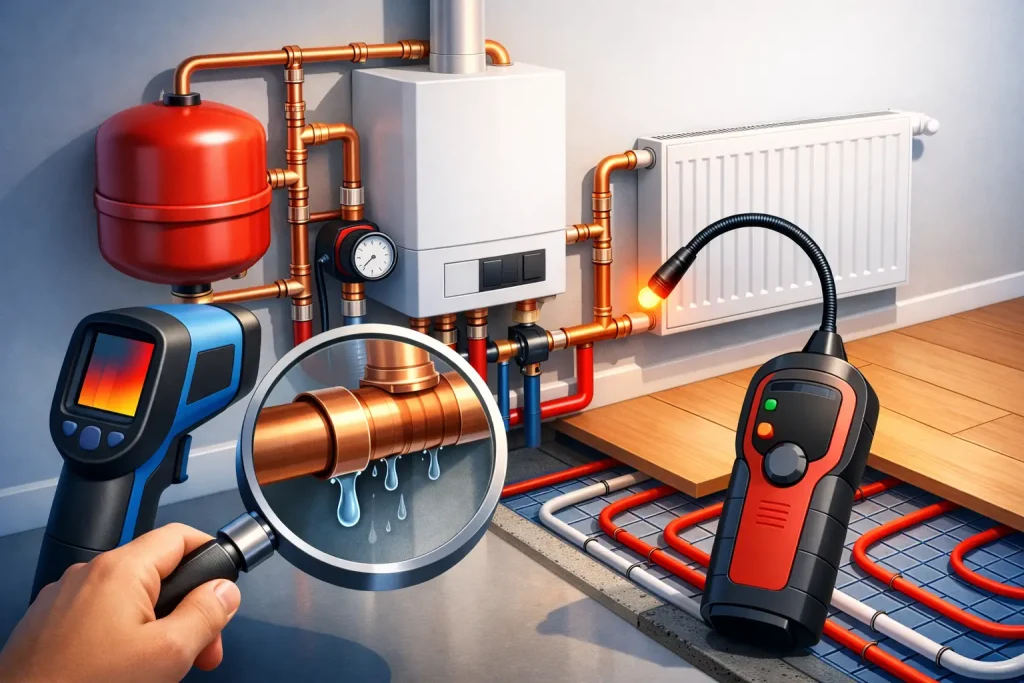
On radiator circuits, individual branches may be valved off and pressure tested to identify whether the leak is in exposed emitters, accessible pipe runs or hidden sections. On underfloor or slab-fed systems, thermal imaging and controlled pressure testing can help locate the area of concern without opening up the whole home. The point is precision. Good diagnostics reduce mess, shorten downtime and avoid unnecessary replacement work.
This is especially important in established or high-end homes where finishes matter. The right approach is not to start cutting. It is to prove where the problem sits first.
What to do while waiting for repair
If you have found a visible leak, turn the heating off and, if safe to do so, isolate the affected radiator or section using the valves. Not every system allows simple isolation, so do not force seized valves. Catch any dripping water, move rugs or furniture clear, and keep an eye on the boiler pressure.
If pressure is dropping rapidly, avoid repeatedly topping the system up. Fresh water introduces oxygen and minerals that can accelerate corrosion and make the system less stable. A single top-up to protect the boiler may be necessary in some cases, but constant refilling is not a fix.
If the leak is near the boiler or any electrical component, leave the area alone and book a qualified hydronic specialist. Fast action matters more than temporary DIY.
The fastest route to the right repair
If you want to know how to find hydronic heating leaks efficiently, think like a diagnostician rather than a parts changer. Start with pressure behaviour. Check the common leak points. Watch for signs of hidden moisture. Then rule out boiler-side faults before assuming pipework is buried and failing.
Some leaks are simple – a radiator valve gland, a relief valve passing, a loose union after years of heat cycling. Others need sectional testing and specialist equipment. The trade-off is time versus certainty. Quick guesswork can feel cheaper at first, but accurate diagnosis is what restores heat faster and avoids replacing a system that is still very repairable.
A well-built hydronic system should give stable, quiet, consistent heat. When it starts losing pressure or behaving unpredictably, treat that as an early warning, not a nuisance to work around. The sooner the fault is properly traced, the better the repair outcome usually is.