
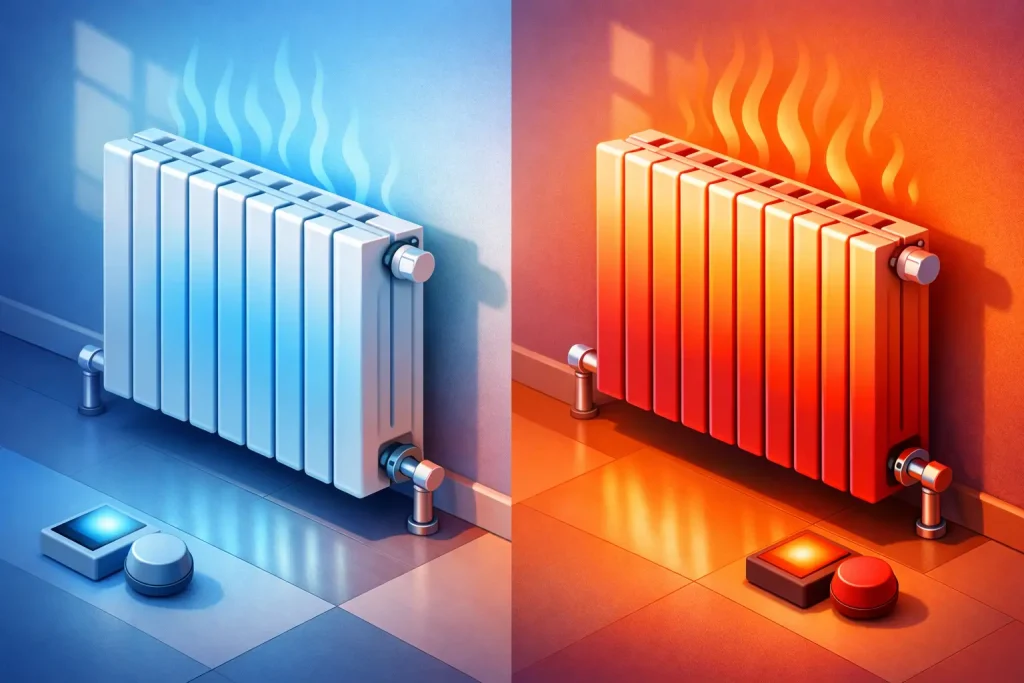
You notice it when the heating has been on for half an hour. One radiator is properly hot, another is only warm at the top, and one in the back room barely seems to wake up at all. If you have been asking why are some radiators hotter than others, the short answer is this: uneven heat usually means the system is out of balance, restricted somewhere, or struggling to circulate water correctly.
In a hydronic system, radiators do not heat by chance. They heat according to water flow, temperature, pressure, and control settings across the whole circuit. That means a hotter radiator is not always a better radiator. Sometimes it is simply the one getting too much of the available flow while others are being starved.
Why are some radiators hotter in the same house?
Radiators in the same property can run at different temperatures for perfectly normal reasons, but only up to a point. A towel rail in a bathroom may feel hotter than a large panel radiator in a living room because it has a different output, a different valve arrangement, or is positioned earlier in the pipe run. Likewise, a room with a thermostat or thermostatic radiator valve set lower may intentionally receive less heat.
That said, obvious differences usually point to a system issue rather than design intent. If one or two radiators are consistently much cooler than the rest, or if the heat-up pattern has changed over time, something has shifted. In our experience, the cause is often one of a few repeat offenders: trapped air, sludge, poor balancing, a sticking valve, a struggling pump, or boiler settings that are no longer right for the property.
The most common causes of uneven radiator heat
Air in the system is one of the simplest causes. When air collects in the top of a radiator, hot water cannot fully occupy the panel, so you end up with cold spots near the top and warmth lower down. This often happens after repairs, pressure loss, or filling the system.
Sludge is different. If a radiator is cold at the bottom but warmer at the top, magnetite and debris may have built up inside. Older systems are especially prone to this, and once sludge starts restricting flow, the radiator can no longer emit heat properly. The problem may not stay local either. Debris can affect valves, pumps and the boiler heat exchanger if it is left unchecked.
Balancing is another major factor. Hydronic systems need each radiator to receive the right share of flow. If the system has never been balanced properly, or if changes have been made over the years, the nearest radiators may pull most of the hot water while those further away lag behind. This is one of the most common reasons homeowners find one side of the house much warmer than the other.
Valves can also cause trouble. A thermostatic radiator valve may stick closed or partially closed, especially after sitting idle through warmer months. Lockshield valves can be mis-set. In some cases the valve head appears to respond, but the internal pin is seized and not opening as it should.
Then there is circulation. If the pump is failing, undersized, set incorrectly, or fighting against blockages, heat distribution becomes patchy. You might notice that upstairs radiators are slow, distant rooms stay cool, or heat improves only when a few radiators are turned off elsewhere.
When uneven heat is normal and when it is not
A small temperature difference between radiators is not automatically a fault. Some systems are designed with different water temperatures or flow rates in mind. A radiator in a hallway may not need to feel as hot as the one serving a large family room with bigger heat loss.
The issue is whether the room is reaching temperature reliably and whether the pattern makes sense. If a radiator is warm but the room is comfortable, that may be acceptable. If the radiator is scorching yet the room still feels cold, the sizing or controls may be wrong. If the radiator used to work well and now does not, the change matters more than the exact surface temperature.
A useful rule is this: predictable differences can be normal, inconsistent or worsening differences usually are not.
How to tell what kind of radiator problem you have
Touch can tell you quite a lot, as long as you are careful. A radiator cold at the top often suggests air. Cold at the bottom points more towards sludge. Warm at one end and cool at the other may indicate poor flow, a partly closed valve, or balancing issues.
Listen as well. Gurgling often indicates air. Clicking valves or a system that surges and then fades can suggest circulation or control problems. If the boiler is firing but only some radiators get hot, that narrows the issue to distribution rather than heat generation.
Look at the wider pattern in the house. If the nearest radiators to the boiler heat quickly and the furthest stay tepid, balancing or pump performance is a likely area to investigate. If a single radiator is underperforming while others are fine, the fault is more likely local to that radiator, its valve, or the branch pipework.
Why are some radiators hotter after bleeding?
Bleeding can improve performance, but it is not a cure-all. If a radiator becomes hotter after bleeding, trapped air was at least part of the problem. If it cools down again soon after, you may have a deeper fault such as low system pressure, air being drawn in, poor automatic air venting, or corrosion-related gas formation in the system.
It is also possible to bleed a radiator and reveal another issue. Once the air is gone, sludge, a stuck valve or weak circulation becomes more obvious because the radiator still does not heat evenly. This is why repeated bleeding without a proper diagnosis often wastes time. The symptom changes, but the cause remains.
What a proper fix usually involves
The right repair depends on the fault. Sometimes it is straightforward: repressurising the system, bleeding radiators correctly, freeing a seized valve pin, or adjusting controls. In other cases, the system needs a more technical approach.
A proper balance is not guesswork. It involves checking how quickly each radiator heats, measuring temperature drop where needed, and adjusting lockshield valves so flow is shared correctly across the property. Done properly, this can transform comfort without replacing radiators that are still serviceable.
If sludge is present, the answer may be a targeted clean, magnetic filtration, chemical treatment, or more extensive power flushing depending on system condition. This is where experience matters. Too little intervention leaves the problem in place. Too aggressive an approach on an older system can expose weak points. Good diagnostics come first.
Pump and boiler settings should also be checked. Modern condensing boilers perform best when system temperatures, flow rates and controls are set correctly. If they are not, you can end up with poor heat distribution and higher petrol use at the same time.
When not to ignore hotter and colder radiators
Uneven radiators are not just a comfort issue. They are often an early warning sign. Poor circulation puts strain on pumps and boilers. Sludge reduces efficiency and can shorten component life. Repeated air ingress may point to pressure problems or developing leaks.
For homeowners in established properties, especially those with older hydronic systems, small symptoms have a habit of becoming urgent winter call-outs. The better approach is to deal with the imbalance while the system is still running and repair options are broader.
Hydronic systems are all we do, and this is exactly why specialist diagnosis matters. A general plumbing approach can miss the interaction between boiler settings, pump performance, radiator balancing and system water quality. The result is often partial fixes, not restored comfort.
What to do next if some radiators are hotter than others
Start with the basics: check whether the system pressure is where it should be, confirm valves are open, and note which radiators are hot, warm or cold and where the cold spots sit. That pattern tells a lot.
If the issue affects more than one radiator, has worsened over time, or keeps returning after bleeding, it is worth having the system assessed properly. A repair-first specialist can usually pinpoint whether the answer is balancing, valve repair, circulation correction, sludge treatment or a wider boiler-side fault.
A warm house should not depend on trial and error. When radiators heat evenly, the whole system works less hard, rooms feel more stable, and winter becomes predictable again. That is the standard your heating should meet.