

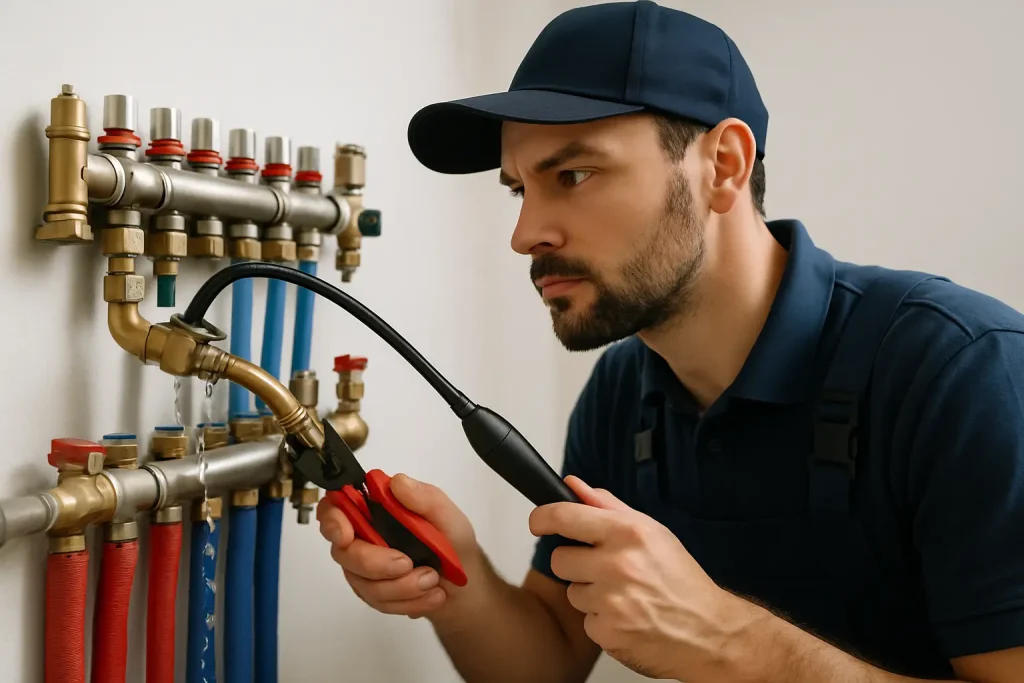
A hydronic leak rarely starts with a puddle.
More often it starts with a boiler that needs topping up more than it used to, a single radiator that keeps going cold, or that faint metallic smell near the plant room that you cannot quite place. In Melbourne winters, those small signals turn into real discomfort quickly – and the longer a leak is left to drift, the more expensive the downstream damage can become.
Hydronic heating leak detection is about speed and accuracy. Not guesswork, not draining a whole system “to see what happens”, and definitely not replacing major components because it is easier than diagnosing properly. Done well, leak detection protects your home, preserves your system, and gets heat back on with the least disruption.
Why hydronic leaks behave differently to plumbing leaks
Hydronic heating is a closed loop. Water circulates through the boiler, pipework and radiators (or in-slab circuits) again and again. That closed-loop design is why hydronics is efficient, but it is also why leaks can be deceptive.
A domestic plumbing leak often shows itself at a tap, toilet, or obvious pipe joint. A hydronic leak can be small enough that it evaporates on a warm pipe, or it can leak only when the system is hot and under pressure. When the system cools, the pressure drops and the leak may appear to “stop”. That is why some homes lose pressure overnight, then seem fine after a top-up, then lose pressure again a day or two later.
There is also a trade-off in how the system is run. Some boilers tolerate regular topping up for a while, but repeated fresh-water refills introduce oxygen and minerals. That accelerates corrosion, encourages sludge, and can shorten the life of pumps, valves and heat exchangers. A slow leak is not just an annoyance – it is a system-wide risk.
The warning signs that usually point to a leak
Homeowners often notice performance issues before they see any water. You do not need to be technical to spot the patterns.
If your boiler pressure drops repeatedly and you find yourself refilling the system, that is the classic sign. Another common clue is bleeding radiators far more often than normal. Air in a hydronic system has to come from somewhere – and a leak is one of the most common entry points.
Cold spots in a radiator, gurgling sounds, or one zone that struggles to warm up can also be related. Not always, though. Sludge, incorrect balancing, pump faults and failing valves can mimic leak symptoms. This is where proper diagnosis matters – because the right fix depends on what is actually happening.
You may also notice staining around radiator valves, skirting boards that look slightly darker, or timber flooring that starts to cup. With in-slab hydronic systems, the first sign might be warm patches where they should not be warm, or unexplained dampness that does not match weather or plumbing use.
Where hydronic systems typically leak
Leaks are usually boring, not dramatic. They tend to happen at points of movement, vibration, or repeated thermal expansion and contraction.
Radiator valves and tails are common, particularly if a radiator has been knocked, if the valve packing has aged, or if there is galvanic corrosion where different metals meet. Automatic air vents can seep over time. Pump unions and isolation valves can weep. On older systems, micro-leaks can develop at soldered joints or threaded fittings that have been through thousands of heating cycles.
Boilers themselves can leak too. Sometimes it is a failed internal seal or pressure relief valve discharge. Sometimes it is a sign of a more serious issue such as a compromised heat exchanger. The difference matters because a relief valve can be the symptom of an underlying pressure or expansion vessel fault rather than the root cause.
With in-slab pipework, leaks are less common but higher consequence. If a line has been damaged, incorrectly installed, or is suffering from long-term material degradation, the leak can be hidden under floor finishes. That is where targeted testing becomes essential – you want certainty before any invasive work starts.
What not to do when you suspect a leak
The first instinct is often to keep topping up and hope it settles. That is understandable when you just want heat back, but it is rarely the cheapest path. Each refill introduces fresh oxygenated water, which can increase corrosion and sludge. If you are topping up weekly, you are not “maintaining” the system – you are masking a fault.
Another common misstep is dumping chemical sealant into the circuit as a first response. There are niche cases where specialist sealants have a place, but as a default they can create problems: blocked valves, fouled sensors, and a system that becomes harder to service properly. If a system is worth keeping, it is worth diagnosing.
Finally, do not ignore pressure relief discharge. If you see the boiler’s discharge pipe dripping outside, it is telling you something about pressure control. The cause might still be a leak, but it could be a failed expansion vessel, a filling loop issue, or incorrect system pressures.
How specialists approach hydronic heating leak detection
Good leak detection is a process, not a gadget. Tools help, but the sequence and interpretation are what save time.
A proper visit starts with a system history: how often pressure drops, whether leaks correlate with heat cycles, whether any recent works have been done, and whether the system is radiators or in-slab (or mixed). Then comes a targeted physical inspection – not just around the boiler, but at the radiators, valves, visible pipe routes, and any penetrations through floors and walls.
From there, the next step depends on what the system is doing.
Pressure testing and isolation to narrow the search
One of the quickest ways to stop guessing is to isolate sections. If you can isolate the boiler from the heating circuit, you can learn whether the pressure loss is in the boiler assembly or out in the distribution pipework and emitters.
Similarly, isolating zones (where the system design allows it) can narrow the leak to a particular area of the home. This matters because it prevents unnecessary disruption – and it helps you avoid draining the entire system repeatedly.
Pressure testing is not just “pump it up and see”. The test pressure, the duration, and whether the system is hot or cold all influence what you learn. Some leaks only reveal themselves when components expand under heat, so a cold static test may pass even though the system fails in operation.
Dye, thermal checks, and acoustic listening
Where access is limited, specialists may use a tracer dye to make seepage visible at a valve or joint. Thermal checks can sometimes highlight abnormal heat patterns, particularly where a leak is affecting circulation.
Acoustic methods can also help, especially for pressurised line leaks. But again, it depends. A busy household, thick slabs, and complex pipe routes can limit what listening equipment can reliably pick up. The best operators treat these as part of a toolkit, not as a promise that technology will magically point to a single tile.
Boiler-side diagnostics that homeowners cannot see
Leak detection often overlaps with component diagnostics. A system that loses pressure may have:
- A genuine water leak somewhere in the loop
- A faulty pressure relief valve that is passing water
- A failed expansion vessel causing pressure spikes and discharge
- A filling loop problem introducing water unpredictably
These are different faults with different fixes. This is also where having the right parts on hand matters, because once the cause is confirmed, delays simply extend the period of no heat (or the risk of water damage).
Repair-first outcomes: what a “good fix” looks like
A good fix stops the pressure loss and restores stable circulation, then leaves the system cleaner and more reliable than it was before the leak.
If the leak is at a radiator valve or joint, the right repair is usually a proper mechanical fix: re-making the joint, replacing the valve, renewing olives or seals, and re-commissioning the radiator afterwards. If the system has been repeatedly topped up, it may also need inhibitor correction, because the chemistry will have been diluted.
If the issue is pressure control, the repair might involve replacing an expansion vessel, servicing or replacing the pressure relief valve, and setting the correct cold fill pressure for the property. The aim is not just “no dripping today”, but stable pressures across full heat cycles.
For hidden leaks, particularly in-slab, it depends. Sometimes a localised repair is possible with minimal disruption if the leak is precisely located. Other times, rerouting pipework or installing a new circuit is the smarter long-term move – especially if the existing pipe is at the end of its service life. A specialist will explain the trade-off plainly: the least invasive option is not always the most durable.
When leak detection turns into an upgrade conversation
Not every leak means replacement, but there are times when upgrade planning is the sensible path.
If a boiler has an internal failure and is already near the end of its life, you may be throwing good money after bad. If the system has chronic corrosion, repeated component failures, or poor efficiency, it can be worth putting repair costs towards a modern condensing boiler and a properly commissioned system.
The key is that the decision should be based on evidence: what failed, why it failed, and what the next 5-10 years is likely to look like if you repair versus upgrade. A good contractor will not push you either way – they will protect you from a false economy.
What to expect from an on-site leak detection visit
For most homes, the goal is same-visit clarity and, where possible, same-visit repair. That means arriving with a structured diagnostic plan, the right test equipment, and common hydronic spares.
You should expect clear communication about what has been checked, what has been ruled out, and what is still unconfirmed. If invasive work is being recommended (lifting boards, opening plaster, cutting access), you should also expect a clear rationale and options to minimise disruption.
If you are in Greater Melbourne and want a repair-first specialist approach, Hydronix is built around fast diagnostics and getting systems others replace back into reliable service – with tidy workmanship and a six-year workmanship guarantee. You can book an appointment via https://www.hydronixheating.com.au.
A warm house is the outcome. The way you get there should feel controlled: the leak found with evidence, the repair done properly, and the system left stable enough that you stop thinking about your boiler pressure altogether.