

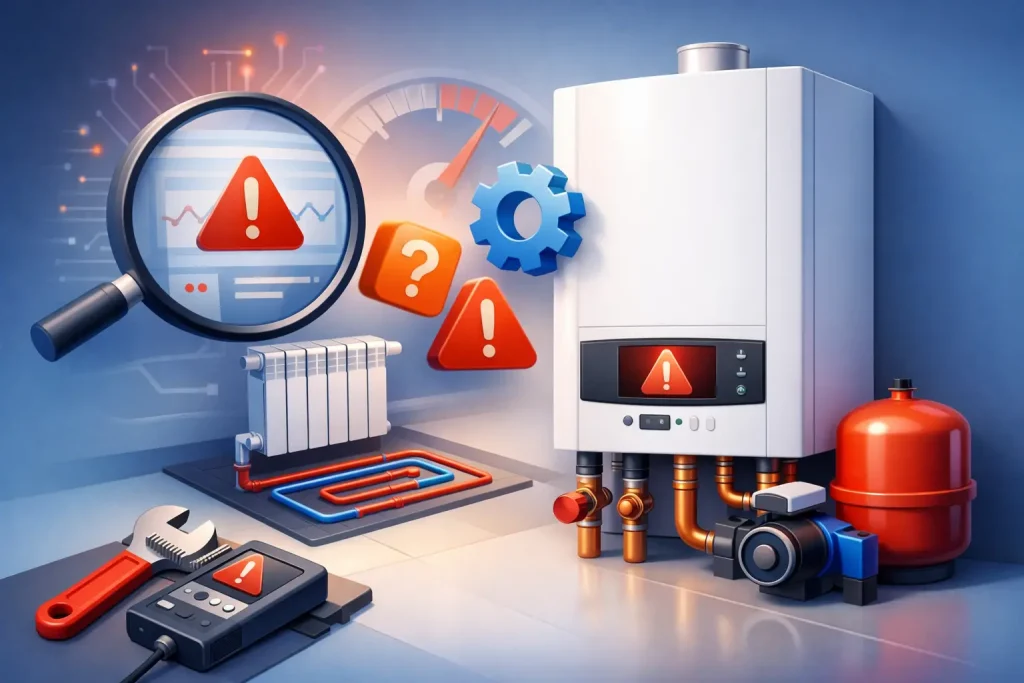
When your heating drops out on a cold morning and the boiler screen flashes an unfamiliar code, you do not need a lecture on electronics. You need hydronic boiler fault codes explained in plain English, with a clear sense of what is minor, what is urgent, and what should never be guessed at. That is exactly how we approach fault finding – fast, practical, and focused on getting heat back on without pushing a replacement that is not needed.
What boiler fault codes are really telling you
A fault code is the boiler’s way of narrowing down where the problem sits. It is not always a final diagnosis. In many cases, the code points to a symptom rather than the root cause.
For example, a low-pressure code may be caused by a small system leak, a failed expansion vessel, air in the system, or a filling loop issue. An ignition fault might be a petrol supply problem, a worn electrode, a condensate issue, or a control board not reading the flame properly. The code matters, but the interpretation matters more.
This is where homeowners often get mixed messages. One contractor reads the code and recommends a new boiler. A specialist reads the code, tests the related components, and repairs the actual fault. Hydronic systems are all we do, so the goal is always to confirm the cause before recommending the fix.
Hydronic boiler fault codes explained by fault type
Different makes use different code formats, but most faults fall into a few broad categories. Once you understand those categories, the display becomes less mysterious.
Low water pressure faults
These are among the most common faults in closed-loop hydronic heating. If the boiler pressure falls below the operating range, the unit may lock out to protect the heat exchanger and pump.
Sometimes the issue is straightforward and pressure simply needs to be restored correctly. Sometimes it is a sign of a radiator valve leak, a relief valve passing water, or an expansion vessel that has lost charge. If pressure keeps dropping, topping it up repeatedly is not the answer. The leak or component failure needs to be found.
Ignition and flame failure faults
These codes usually appear when the boiler tries to fire but cannot establish or prove a stable flame. You may hear the unit attempt to start, then shut down.
Possible causes include interrupted petrol supply, a dirty or failed ignition electrode, flame detection issues, poor combustion setup, or condensate restrictions on condensing boilers. It depends on the model and the pattern of the failure. A reset may clear a one-off interruption, but repeated flame faults should be tested properly.
Overheat faults
An overheat code means the boiler has detected temperatures beyond its safe operating range. That does not always mean the boiler itself is producing too much heat. It can also mean heat is not moving away from the heat exchanger as it should.
Common causes include pump failure, airlocks, blocked strainers, closed valves, sludge in older systems, or sensor issues. If the boiler is overheating because circulation is poor, simply resetting it will not solve the problem for long.
Sensor and thermistor faults
Modern boilers rely on temperature sensors to regulate operation. When one of those sensors fails or sends readings outside the expected range, the boiler may shut down or run erratically.
This type of fault can be relatively contained if it is a failed sensor and the part is available. It can also become more involved if wiring, moisture ingress, or the control board is affecting the signal. Good diagnostics matter here because replacing the wrong electrical part wastes time and money.
Fan, air pressure and flue-related faults
Room-sealed boilers monitor fan speed and air pressure to make sure combustion gases are moving safely. If the fan does not start, the air pressure switch does not prove, or the flue conditions are not correct, the boiler will usually lock out.
These faults need care. They may involve fan assemblies, pressure sensing tubes, blocked terminals, condensate within flue components, or electrical control issues. They are not suitable for trial-and-error repairs.
Condensate faults on condensing boilers
High-efficiency condensing boilers produce condensate as part of normal operation. If the trap blocks, the pipework freezes, or drainage is restricted, the boiler may shut down with a lockout code that can easily be mistaken for an ignition problem.
This is one reason model-specific experience matters. The same visible symptom can point to different root causes depending on the boiler design.
What you can safely check before booking a repair
There are a few sensible checks a homeowner can make without opening the boiler casing or interfering with petrol components. First, confirm whether the display shows a steady fault code or whether the boiler is cycling on and off. Second, check the system pressure gauge if your setup has one and note whether it is unusually low.
It also helps to see whether the issue affects the whole house or only part of it. If the boiler is running but one radiator is cold, that points in a different direction from a full boiler lockout. Likewise, if underfloor heating is affected but radiators still work, the fault may sit in a zone control rather than the boiler itself.
If the manufacturer allows a user reset, one reset attempt is reasonable. More than that usually just delays proper diagnosis. If the same code returns, the boiler is telling you the fault is still present.
When a fault code means stop and call a specialist
Some situations should not be handled as a home fix. If you smell petrol, hear unusual banging from the boiler, see water leaking from the unit, or have repeated lockouts with no stable operation in between, switch the system off and arrange a professional inspection.
The same applies if pressure is falling regularly, if the condensate is backing up internally, or if the fault involves combustion, fan, flue or overheating safety circuits. Boiler codes can look simple on the screen, but the system behind them is not. Guesswork can turn a repair into a bigger failure.
Why fault codes alone do not justify replacing the boiler
This is where homeowners often get caught. A boiler throws a code, the unit is called old, and replacement is presented as the only sensible option. Sometimes that is correct. Often it is not.
A specialist looks at age, parts availability, efficiency, overall system condition and the specific failed component. A ten-year-old boiler with a failed sensor, pump or ignition part is very different from a severely corroded unit with multiple recurring faults and poor combustion performance. We fix systems others replace because proper diagnosis usually reveals whether the fault is isolated, systemic, or simply overdue maintenance.
There is also the wider hydronic system to consider. Sludge, poor water quality, air ingress, worn valves and control issues can all trigger boiler fault behaviour. Replacing the boiler without addressing those conditions may leave the new unit vulnerable to the same problems.
How a proper hydronic fault diagnosis works
Good diagnosis follows a sequence. The fault code is recorded first, but that is only the starting point. The boiler’s operating history, pressure behaviour, ignition pattern, circulation performance and control signals all need checking.
From there, the technician tests the components that relate to the code rather than replacing parts blindly. On a pressure fault, that may involve expansion vessel charge, relief valve condition and leak tracing. On an ignition fault, it may include petrol supply checks, electrode inspection, combustion analysis and condensate assessment. On an overheat fault, pump operation and system flow become central.
That process is why repair-first specialists carry common spare parts and know the recurring failure patterns across major boiler brands. Speed is not just about arriving quickly. It is about being ready to diagnose accurately and complete the repair on the first visit where possible.
Preventing the same code from coming back
Many repeat faults are preventable. Annual servicing helps, but only if it is more than a box-ticking exercise. A proper hydronic service should check combustion performance where applicable, system pressure behaviour, safety components, pump operation, water quality and visible leaks.
It is also worth paying attention to the small signs before a lockout happens. Radiators taking longer to warm up, pressure drifting down, gurgling pipework, uneven heat across zones, or a boiler that needs resetting now and then are all early warnings. Acting at that stage is usually cheaper and less disruptive than waiting for a complete breakdown in winter.
For homeowners who want certainty, the safest approach is simple. Record the fault code, note any pressure reading or visible leak, and book a specialist who works on hydronic systems every day. If you are in Melbourne, Hydronix focuses on repair-led hydronic diagnostics with the parts, experience and workmanship standards to restore heat properly. The right code reading does not just explain the problem – it points to the most sensible fix.