
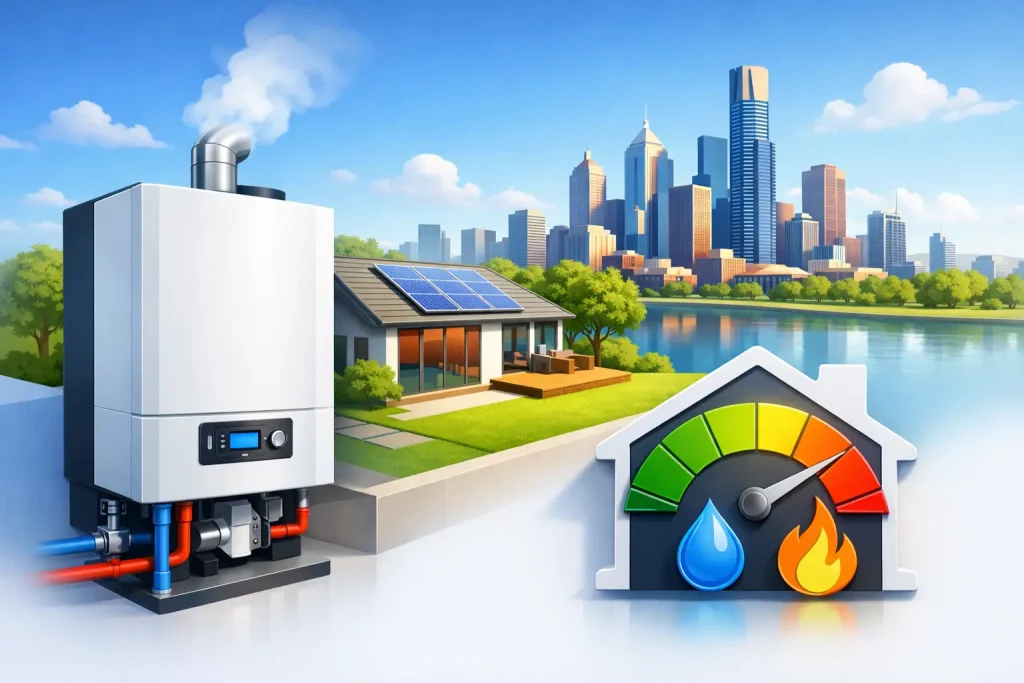
Melbourne winters expose every weak point in a hydronic heating system. If your home takes too long to warm up, some radiators lag behind others, or your petrol bills keep climbing, condensing boiler efficiency Melbourne homeowners expect often comes down to one thing: whether the boiler and system are actually set up to condense properly.
That matters because a condensing boiler is not automatically efficient just because of the name on the casing. The advertised figures only happen in the right conditions. Water temperatures, radiator sizing, controls, pipework condition and overall system balance all play a part. When those elements are right, a condensing boiler can deliver steady comfort with noticeably lower fuel use. When they are wrong, you can end up paying for premium equipment without seeing the benefit.
What condensing boiler efficiency means in Melbourne homes
A condensing boiler extracts extra heat from the flue gases that older boilers waste. It does this by cooling those gases enough for water vapour to condense, which releases additional usable heat back into the system. In plain terms, it squeezes more warmth from the same amount of petrol.
In Melbourne, that can be especially worthwhile because many homes rely on hydronic heating for long, consistent winter operation rather than short bursts. The longer the system runs under the right temperatures, the more opportunity a condensing boiler has to operate as intended.
There is a catch. Condensing performance depends on lower return water temperatures. If your system is sending water back to the boiler too hot, the unit may still heat the house, but it will not achieve its best efficiency. That is why boiler choice alone is never the full answer.
Why some systems never reach proper condensing boiler efficiency in Melbourne
The biggest issue we see is mismatch. A new condensing boiler gets connected to an older hydronic system without enough attention to how that system behaves. The boiler may be excellent, but the surrounding setup prevents it from doing its best work.
Oversized or poorly configured boilers are one cause. If a boiler is too large for the home’s actual heating load, it tends to cycle on and off instead of running in longer, efficient periods. Frequent cycling wastes fuel, increases wear and often leads to uneven comfort.
High flow temperatures are another common problem. Many older systems were designed around hotter water, particularly where heat loss is significant or radiators are undersized. A condensing boiler can still be installed in these homes, but the efficiency gain may be smaller unless the system is adjusted to allow lower operating temperatures.
Then there is system condition. Sludge, poor circulation, air in the pipework, sticking valves and ageing pumps all affect performance. If radiators are not emitting heat properly, homeowners often respond by turning the thermostat up, which pushes energy use higher without fixing the real fault. This is one reason repair-first diagnostics matter. We fix systems others replace because efficiency losses are often caused by faults around the boiler, not the boiler alone.
The factors that make the biggest difference
Boiler modulation is important, but it is only part of the picture. The system needs to be balanced so each radiator receives the right flow. If one room overheats while another stays cool, the boiler works harder than necessary and comfort suffers.
Controls also matter more than most homeowners realise. A modern condensing boiler paired with poor controls can still run wastefully. Proper time and temperature control, weather compensation where suitable, and correct zoning allow the boiler to respond to actual heat demand instead of simply firing at high output.
Radiator size affects efficiency too. Larger emitters can deliver the required room heat at lower water temperatures, which helps the boiler stay in condensing mode for longer. That does not mean every home needs all-new radiators. Sometimes a few targeted upgrades in colder areas of the house are enough to improve the whole system.
Insulation and draught control sit in the background of this discussion, but they are relevant. A boiler can only compensate for heat loss up to a point. In period homes and larger Melbourne properties, poor envelope performance can force higher operating temperatures, reducing condensing gains.
When a condensing boiler upgrade is worth it
If your current boiler is unreliable, costly to run or difficult to repair due to parts availability, an upgrade can make clear financial sense. The strongest case is usually where the existing unit is older non-condensing technology, the household uses heating regularly through winter and the rest of the hydronic system is in serviceable condition.
That said, replacement should not be automatic. A good specialist will inspect the whole system first. If the boiler fault is repairable and the appliance still has useful life left, repair may be the better value option. We see too many homeowners steered towards full replacement when a targeted repair and proper service would restore safe operation and decent performance.
Where replacement is the right call, the upgrade should be planned around the property, not around a one-size-fits-all product pitch. Heat load, emitter capacity, domestic hot water requirements and controls all need to be considered together. That is how you get an upgrade that performs well in July, not just on paper.
How to improve condensing boiler efficiency Melbourne homeowners already have
If you already own a condensing boiler, there may still be room to improve performance without major works. Servicing is the first step. A boiler that has not been maintained can lose efficiency through burner issues, blocked condensate components, incorrect combustion settings or sensor faults.
System water quality is equally important. Dirty system water reduces heat transfer and puts strain on pumps and valves. Power flushing is not the answer in every case, but cleaning, inhibitor treatment and filtration can make a substantial difference where contamination is present.
Balancing the radiators is often overlooked because it is not visible, but the effect is real. A balanced system warms more evenly, reduces unnecessary boiler strain and can help lower return temperatures. The result is better comfort and more consistent condensing operation.
It is also worth reviewing the flow temperature. Many boilers are left set higher than necessary. In the right property, reducing the flow temperature can improve efficiency while maintaining comfort. This needs to be done carefully, because if the home cannot heat properly at the lower setting, the change simply creates complaints. It depends on radiator output, insulation and the home’s actual heat loss.
Repair, service or replace?
This is the decision most homeowners want answered quickly, especially when the house is cold. The honest answer is that it depends on age, fault history, parts support and overall system condition.
If the issue is isolated – such as a failed component, circulation fault or control problem – repair is often the fastest and most cost-effective path. If the boiler has repeated breakdowns, poor combustion performance, significant corrosion or limited parts support, replacement becomes easier to justify.
What should never happen is guessing. A proper onsite diagnosis gives you a clear picture of what has failed, what can be repaired immediately and whether the wider system is holding efficiency back. That is the value of using a hydronic specialist rather than a general plumber learning the system in your hallway.
Choosing the right specialist for efficiency work
Condensing boiler efficiency is not just about installing a newer appliance. It is about understanding hydronic systems as a whole – boilers, radiators, pumps, valves, controls and water quality working together. If that expertise is missing, homeowners often end up with a technically new system that still performs like an old one.
Look for a contractor who can diagnose before prescribing, who carries common parts, and who is prepared to discuss repair alongside replacement. Ask how they assess boiler sizing, whether they check combustion and system balance, and how they approach controls and temperature settings after installation. Those details are where long-term efficiency is won or lost.
For homeowners across Greater Melbourne, the goal is straightforward: reliable heat, stable running costs and no unnecessary replacement. That is exactly where a specialist service makes the difference. Hydronic systems are all we do, and that focus matters when you want efficiency improvements that hold up through every winter.
A condensing boiler should make your home feel warmer, calmer and cheaper to run – not more complicated. When the boiler, controls and hydronic system are matched properly, you get the result you paid for. If your system is underperforming, start with a proper diagnosis and let the numbers, not assumptions, decide the next step.