
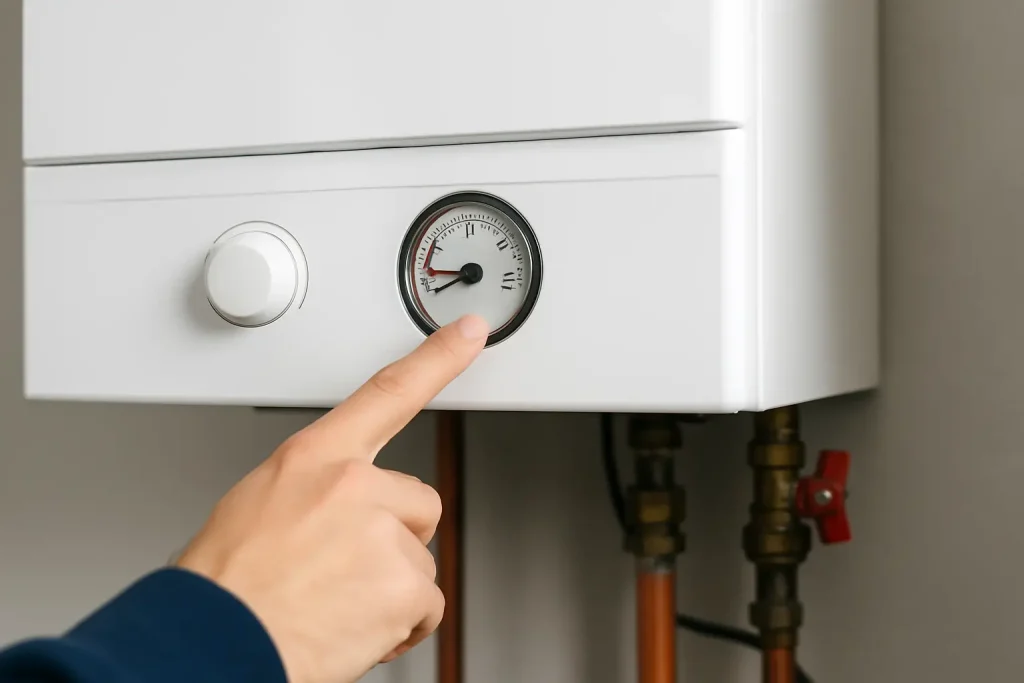
You notice it on a cold morning: radiators that used to heat evenly are now lukewarm, the boiler sounds different, and the pressure gauge has slipped down again. If you keep topping it up, it will often keep you warm for a day or two – until it doesn’t. A hydronic boiler pressure dropping repeatedly is not “one of those things”. It is the system telling you water is leaving the sealed circuit, or the boiler is not keeping the circuit pressurised.
The good news is that most causes are diagnosable quickly, and many are repairable without replacing the boiler. The key is knowing what’s safe to check yourself, what’s likely happening behind the scenes, and when topping up is masking a fault that can damage components.
What “normal” pressure looks like in a hydronic system
Most sealed hydronic heating systems run at a relatively modest cold pressure, often around 1.0 to 1.5 bar when the system is off and cool. When the boiler heats up, that pressure rises because water expands. Seeing it climb somewhat in operation is normal.
What isn’t normal is pressure that drifts down over hours or days, or a gauge that regularly drops near zero. When the pressure is low, circulation suffers, air can be pulled into the system, and the boiler’s safety controls may lock out to protect the heat exchanger. In real terms, you get cold patches in radiators, noisy pipes, and an unreliable system when you need it most.
Why hydronic boiler pressure dropping happens
A sealed heating circuit doesn’t “use up” water. If pressure drops, something is letting water out, letting air in, or failing to manage expansion properly.
1) A leak somewhere in the heating circuit
This is the most common reason pressure keeps falling. The tricky part is that hydronic leaks are often small and intermittent. They can evaporate on a hot pipe run, soak into insulation, or appear only when the system heats up and joints expand.
Leaks can occur at radiator valves, compression fittings, bleed points, circulation pump flanges, manifold connections, or hidden pipework. In older properties, corrosion and sludge can also weaken components over time.
A useful rule: if you have to top up more than once, assume there is a leak until proven otherwise.
2) The pressure relief valve is discharging
Every boiler has a pressure relief valve (PRV) designed to open if pressure becomes unsafe. If the PRV has lifted even once, it may not reseal perfectly. That can create a slow drip that you might only notice as a damp patch near the discharge pipe.
This fault often links to another issue – an expansion vessel problem (below) – because if the system can’t absorb expansion, pressure spikes during heat-up and forces the PRV to open. The system then cools down and sits at a low pressure, and the cycle repeats.
3) The expansion vessel has lost its air charge (or failed)
In a sealed system, the expansion vessel acts like a cushion. It contains a diaphragm with air on one side and system water on the other. If the air charge is low, or the diaphragm fails, the system has nowhere to put expansion volume when heating.
What you tend to see at home is a pressure gauge that rises quickly when the boiler fires, sometimes nearing the upper limit, and then drops very low when it cools. Homeowners often interpret this as “the boiler can’t hold pressure”, but it’s usually an expansion control issue rather than a mysterious leak.
4) Air being introduced, then bled out
If air is getting into the system (through a slight leak, poor topping-up practice, or failing automatic air vents), it can collect in radiators and high points. When you bleed radiators to remove the air, you also release pressure – which then prompts another top-up.
Bleeding is worthwhile, but it should not become a weekly ritual. Regular air suggests an underlying entry point, not bad luck.
5) Filling loop or top-up valve not behaving correctly
Some systems have a manual filling loop; others have a more integrated top-up arrangement. If that hardware leaks externally, it can be obvious. If it doesn’t open properly, you may struggle to raise pressure. And if it’s been left partially open, it can overpressurise the system, making the PRV discharge and creating the illusion of a “pressure loss” problem.
This is one reason we treat pressure faults as a whole-system diagnosis rather than a single-part swap.
What you can safely check at home (without guessing)
There are a few checks that are genuinely homeowner-friendly. They won’t replace a proper diagnostic, but they can help you avoid damage and give you clear information to pass on when booking a repair.
Check the gauge when the system is cold
Do this first thing in the morning before the heating has been running. Note the pressure. Then run the heating for 15-20 minutes and note how high it climbs. A big swing up and down often points to expansion vessel or PRV issues, whereas a steady downward drift over days leans more towards a leak.
Look for obvious discharge from the relief pipe
If you can safely see the boiler’s discharge pipe termination, look for signs of recent water – damp patches, staining, or a steady drip. Do not block or cap this pipe. If it’s discharging, it is doing its job, and the cause needs fixing.
Check radiator valves and visible joints for staining
You’re not hunting for a dramatic puddle. Look for greenish or whitish residue, rust streaks, or a faint tide mark. Pay attention to radiator tails, thermostatic radiator valves, lockshields, and any accessible manifold cabinet.
Top up only if pressure is genuinely too low
If the boiler is locked out due to low pressure, a careful top-up can restore heat while you arrange service. Bring pressure up slowly to the manufacturer’s recommended cold range, then close the filling loop fully. If you are unsure, stop and book a specialist. Overfilling can create a second fault by driving pressure high and lifting the PRV.
When topping up becomes a problem
Repeatedly adding fresh water can accelerate corrosion inside the system. Fresh water carries oxygen and minerals, and it dilutes any inhibitor that’s protecting your pipework and radiators. If your hydronic boiler pressure dropping has turned into a weekly top-up, you’re not just dealing with inconvenience – you’re increasing the chance of sludge, stuck valves, noisy circulation, and premature component wear.
There’s also a practical risk: a hidden leak can worsen quickly. What starts as a slow loss can become a significant escape once a joint finally gives way.
How a specialist diagnoses pressure loss quickly
Pressure faults are one of those jobs where experience matters, because the symptoms overlap. A proper diagnostic typically combines visual inspection, pressure testing, and component checks to isolate the root cause rather than chasing it.
A good technician will look at the cold pressure, observe the hot running pressure, check for PRV weeping, verify the expansion vessel charge and condition, and inspect common leak points throughout the circuit. If the leak isn’t visible, they may isolate zones (where possible) to narrow down whether the boiler, distribution pipework, or emitter circuit is losing pressure.
The goal is simple: stop the pressure loss, restore stable circulation, and leave you with a system that can run for months without you touching the filling loop.
Repair-first outcomes: what usually gets fixed
Most pressure-drop jobs end up being one or a combination of the following: replacing a tired PRV, recharging or replacing an expansion vessel, repairing a weeping radiator valve, resealing a joint, or replacing an automatic air vent that’s passing. None of those automatically mean a boiler replacement.
Replacement only becomes sensible when there are multiple major issues at once – for example, a compromised heat exchanger alongside severe corrosion throughout the system – and even then it depends on parts availability, the age of the unit, and the broader condition of the pipework and radiators. A repair-first approach keeps costs predictable and avoids turning a targeted fault into a disruptive project.
Booking the right help (and what to ask)
If you’re choosing a contractor, look for someone who works on hydronic heating as a core service rather than as an occasional add-on. Pressure-drop faults can be deceptively quick to “patch” and annoyingly persistent if the underlying cause is missed.
When you book, tell them how often you’re topping up, what the cold pressure is, how high it rises when running, and whether you’ve seen any discharge outside. If you want a specialist repair-first team that carries common parts to complete fixes on the first visit, Hydronix fits that brief – hydronic systems are all they do, and you can book through book a hydronic repair.
A closing thought for winter reliability
If the gauge is falling, treat it like a warning light, not a routine chore. The fastest path back to dependable warmth isn’t constant topping up – it’s finding the specific point where pressure is being lost and fixing it once, properly, so the system can run quietly in the background the way hydronic heating should.